
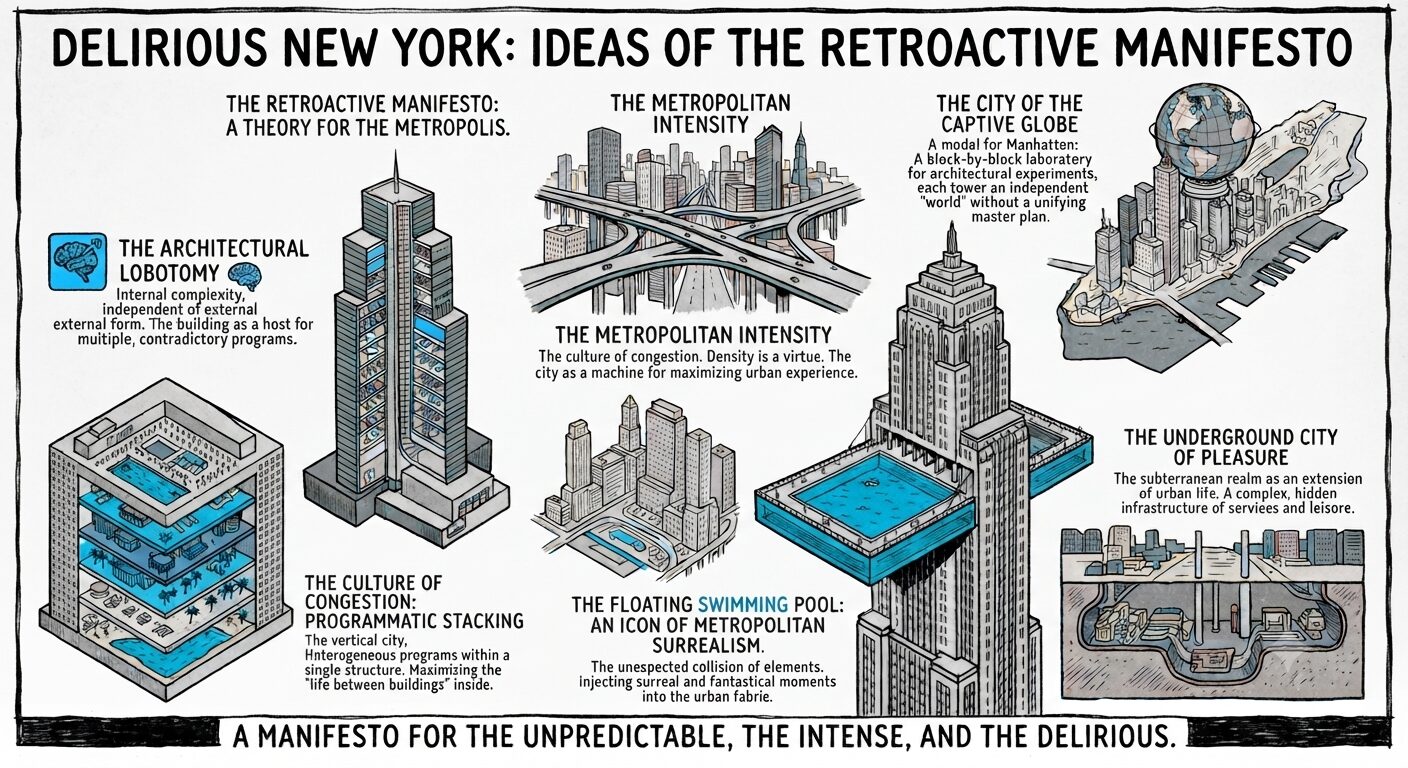
Rem Koolhaas’s Delirious New York remains one of the most influential architectural texts of the twentieth century because it rejects conventional urban planning in favor of celebrating Manhattan’s apparent chaos. Through the idea of the “retroactive manifesto,” Koolhaas argues that the city’s congestion, contradictions, and programmatic instability were not failures but the very forces that made New York a unique metropolitan experiment. Instead of imposing a rigid master plan, Manhattan evolved through countless independent decisions, creating a city of extraordinary density, diversity, and architectural innovation. His manifesto transforms what many viewed as disorder into a productive urban condition.
Yet this reinterpretation also raises an important question: does celebrating Manhattan’s contradictions risk confusing historical accident with urban virtue? Koolhaas often presents congestion and unpredictability as inherently creative, but the same conditions were also shaped by speculative capitalism, unequal development, and environmental exploitation. By reading the city’s evolution as an architectural triumph, the manifesto tends to overlook the economic and political systems that produced both its iconic skyline and its deep social inequalities.
One of Koolhaas’s central ideas is the culture of congestion, where density is portrayed as a catalyst for innovation and urban life. In this view, the crowded metropolis generates unexpected encounters and allows multiple, conflicting programs to coexist within the same building. While density can indeed encourage diversity and efficiency, it is not inherently emancipatory. Without equitable governance and inclusive planning, density can also intensify inequality by concentrating wealth, surveillance, and exclusion. The vertical city often separates rather than unites its inhabitants, placing luxury residences, commercial offices, affordable housing, and infrastructure into distinct social hierarchies. Programmatic stacking therefore becomes not only a symbol of architectural freedom but also a mechanism of vertical segregation.
Similarly, Koolhaas’s concept of the City of the Captive Globe celebrates Manhattan as a laboratory where every block becomes an independent experiment free from overarching control. This vision romanticizes constant innovation and architectural competition. However, experimentation is never politically neutral. The freedom to reshape the city has historically depended upon displacement, speculative real-estate development, and the commodification of public space. The manifesto celebrates the city as a field of endless possibility but pays comparatively little attention to those who bear the consequences when these experiments fail or when redevelopment displaces established communities.
Another recurring theme in Delirious New York is architectural lobotomy—the deliberate separation of a building’s exterior form from its complex interior functions. Koolhaas argues that this disconnect allows architecture to accommodate multiple programs without being constrained by traditional notions of form. While this flexibility anticipated many contemporary building types, it also foreshadowed the rise of generic, globally interchangeable towers. In today’s cities, flexibility often serves financial efficiency more than civic life, producing buildings optimized for investment rather than local identity, climate, or cultural context. What Koolhaas celebrated as liberation from formal constraints can therefore be interpreted as architecture’s increasing submission to the demands of capital.
The famous image of the floating swimming pool, one of Delirious New York’s most memorable symbols, illustrates this contradiction particularly well. Koolhaas presents it as a surreal collision of programs that exemplifies the creative possibilities of metropolitan life. Yet from a contemporary perspective, the floating pool also evokes a city where spectacular amenities are increasingly privatized and accessible only to a privileged few. The image no longer represents pure urban optimism; it reflects a broader reality in which architectural spectacle often obscures the social and infrastructural inequalities that sustain it.
This critique does not diminish the importance of Delirious New York. Koolhaas fundamentally changed the way architects understand cities by demonstrating that contradiction, complexity, and density could themselves become productive design principles. His work challenged the rigid modernist belief that cities must be ordered according to comprehensive master plans. Nevertheless, the conditions of the twenty-first century demand a broader framework for evaluating urban success. Climate change, housing affordability, environmental resilience, and social justice require planners and architects to ask questions that extend beyond metropolitan intensity.
Rather than celebrating unpredictability as an end in itself, contemporary urbanism must ask more fundamental questions: Who benefits from congestion? Who controls architectural flexibility? Who is displaced by experimentation? Can a city remain dense, innovative, and economically vibrant while also being socially equitable and ecologically regenerative? These questions expose the limits of Koolhaas’s manifesto by revealing that urban complexity is inseparable from systems of power, governance, and responsibility.
If Delirious New York served as the manifesto of twentieth-century metropolitan capitalism, the twenty-first century requires a different manifesto—one that values not only intensity and innovation but also accountability, inclusion, and environmental stewardship. The challenge is no longer to romanticize the city’s contradictions, but to distinguish genuine urban creativity from the ideologies that justify inequality.
Delirium was never neutral. What Koolhaas celebrated as metropolitan freedom often functioned as capital’s freedom from accountability.

Leave a Reply