
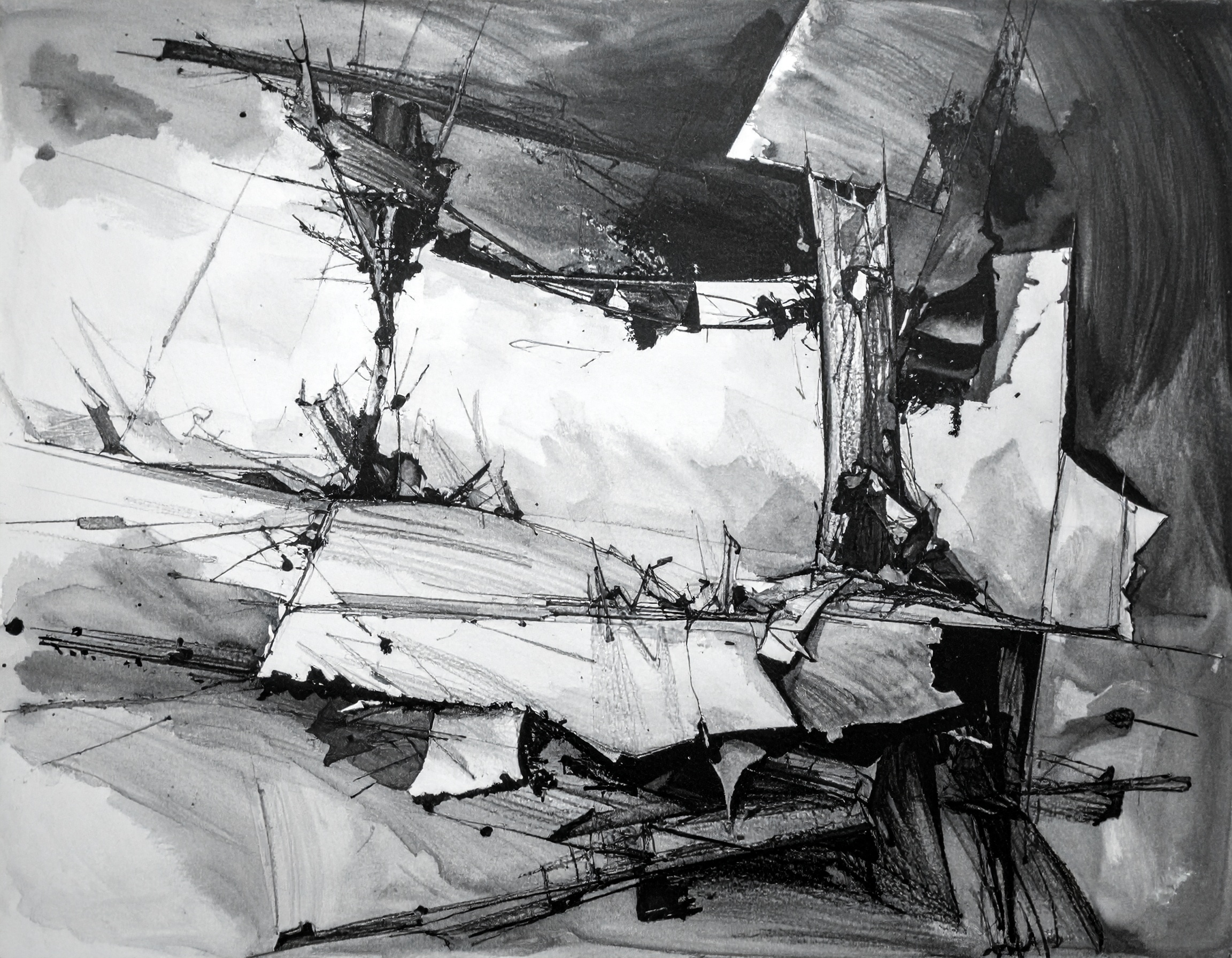
A drawing is not a representation of space.
It is a space.
Before architecture becomes matter, it exists as an arrangement of relationships: distance, proximity, enclosure, direction, interruption, threshold. The drawing does not merely describe these things. It constructs them.
A line is never only a line.
It is an edge.
It separates what is here from what is there. It establishes a before and an after, an inside and an outside. With one stroke, an undifferentiated surface acquires a boundary, and with the boundary comes the possibility of inhabitation.
This is where architecture begins—not in the building, but in the construction of difference.
I place a line upon paper and suddenly the paper is no longer continuous.
Something has happened.
A territory has been claimed.
A distance has been made measurable.
An invisible order has entered the world.
The drawing is small, but the space it constructs is not.
I often think that when I draw a plan, I am not looking from above.
I am inventing an above.
The plan creates a position from which space can be understood without being physically occupied. It suspends the body and replaces it with an eye that can move through walls, cut through floors, pass between rooms, see what the body cannot see simultaneously.
The drawing invents a body without a body.
It allows me to stand nowhere and everywhere at once.
Perhaps this is why architectural drawing feels strangely close to memory.
Memory does not preserve space exactly as it was. It reconstructs it. It removes certain walls, enlarges certain rooms, darkens certain corridors, brings one window closer than it ever was. What remains is not the geometry of the place but its spatial consciousness.
A drawing does something similar.
It does not contain a building.
It contains the conditions through which a building can be imagined.
A plan is therefore not flat.
Its surface is only the threshold.
Behind the surface, space begins to unfold.
A line becomes a wall.
A wall produces an interval.
The interval becomes a room.
The room acquires a direction.
The direction produces movement.
Movement produces sequence.
And sequence produces time.
Suddenly, a two-dimensional mark has become temporal.
You can enter it.
You can move through it.
You can pause within it.
You can imagine light changing across its surfaces.
The drawing has begun to behave like architecture.
Perhaps this is what makes architectural drawing different from an image.
An image asks to be looked at.
A spatial construct asks to be entered.
Even when the paper remains still, the mind begins to move.
The eye crosses the threshold of a line.
It follows a corridor.
It turns.
It encounters an opening.
It arrives somewhere.
The drawing has become a journey without distance.
This is why I do not think of drawing as a preliminary act.
To call it preliminary is to place it beneath the building, as though it were merely waiting for architecture to become real.
But the drawing is already an architectural event.
The building is one of its possible materializations.
The drawing is where space first acquires thought.
Perhaps architecture is not born when the wall is constructed.
Perhaps it is born when the wall becomes imaginable.
And imagination, unlike matter, has no fixed scale.
A small drawing can contain a city.
A few marks can imply a horizon.
A darkened rectangle can become a room.
An empty field can become a courtyard.
A void can become the most important space in the entire project.
This is the paradox of drawing:
what is drawn is often less important than what is left undrawn.
The white of the paper is not empty.
It is potential.
It is the unconstructed territory against which construction becomes legible.
A wall is understood because there is space beside it.
A room exists because something is not the room.
An opening is meaningful because there is something to open.
Architecture is therefore composed not only of things, but of relationships between things.
And the drawing makes these relationships visible.
It gives absence a geometry.
It gives silence an edge.
It gives distance a dimension.
Perhaps that is why erasure is as important as drawing.
When I erase a line, I do not simply remove information.
I alter the spatial world.
A wall disappears.
A room expands.
A circulation changes.
An entire sequence of movement may collapse because one boundary has been taken away.
The eraser is not the opposite of architecture.
It is one of its instruments.
To draw is to construct.
To erase is to reconstruct.
Every architectural drawing is therefore provisional, not because it is incomplete, but because space itself is never entirely settled.
There is always another relationship possible.
Another threshold.
Another distance.
Another way of entering.
Another way of remaining.
The hand knows this before the mind does.
A line hesitates.
It thickens.
It disappears and returns.
The drawing records not only the decision but the uncertainty surrounding it.
Perhaps this is why a good drawing does not feel entirely resolved.
There is something left for the imagination to complete.
It does not explain space completely.
It gives space enough structure to begin explaining itself.
This is where the drawing becomes a strange kind of architecture.
The architect is no longer simply making marks.
The architect is making conditions under which the mind can inhabit marks.
A plan is an invitation.
A section is a cut through possibility.
An elevation is a negotiation between surface and depth.
A perspective is not merely a view but a position from which the world agrees to appear.
Even the most abstract diagram contains an implicit body.
Someone is standing somewhere.
Someone is approaching.
Someone is crossing.
Someone is looking.
Someone is inside.
Someone is outside.
The human body is present even when it is absent from the drawing.
Perhaps every architectural drawing is therefore an agreement between the body and space.
The drawing asks:
Where will you stand?
What will you see?
What will you not see?
Where will you turn?
Where will you stop?
What will contain you?
What will release you?
These questions are not annotations.
They are architecture.
And so the drawing begins to possess something more than geometry.
It possesses time.
A space is never experienced all at once.
It reveals itself sequentially.
A door hides the room beyond it.
A corridor delays arrival.
A stair changes the horizon.
A wall conceals something that the body wants to know.
Architecture is experienced through revelation and withholding.
The drawing, too, can construct this temporal condition.
It can make the eye wait.
It can make the mind anticipate.
It can create a space that is not visible but understood.
Perhaps the most powerful space in a drawing is sometimes the space that cannot be seen.
The room behind the wall.
The courtyard beyond the threshold.
The stair disappearing below the cut.
The landscape beyond the frame.
The drawing constructs not only what exists, but what remains beyond existence.
This is why I sometimes think that architecture is an art of incomplete seeing.
We never experience a building in its entirety.
We inhabit fragments.
A wall.
A ceiling.
A patch of light.
A sound from another room.
A glimpse through an opening.
The drawing, paradoxically, can make this fragmentation more complete.
It allows the mind to assemble what the body can only encounter sequentially.
It becomes a space of simultaneous possibilities.
In a single sheet, the plan can coexist with the section, the section with the elevation, the elevation with the detail.
Different spatial truths occupy the same surface.
The drawing is therefore not only a projection of architecture.
It is a compression of architecture.
Space folded into notation.
Time folded into geometry.
Movement folded into lines.
Matter folded into marks.
And yet something remains unfolded.
The imagination.
That is where the drawing ultimately lives.
Not on the paper.
Not even in the architect’s hand.
It lives in the interval between the mark and the mind that receives it.
A drawing is successful when it begins to exceed itself.
When the line stops being ink and becomes a boundary.
When the blank stops being paper and becomes air.
When the rectangle stops being a shape and becomes a room.
When the section stops being a cut and becomes weight, gravity, height.
When the drawing is no longer something we look at,
but somewhere we find ourselves.
Then the drawing has become a spatial construct.
It has acquired depth without thickness.
It has acquired enclosure without walls.
It has acquired movement without bodies.
It has constructed a place without occupying the earth.
Perhaps this is why the architect draws even when the building may never be built.
Because drawing is not merely preparation for architecture.
It is architecture in another state.
A quieter state.
A weightless state.
A state in which walls can still move, rooms can still disappear, distances can still change, and possibilities remain open.
The built world eventually hardens.
The drawing does not.
It remains capable of becoming.
And perhaps that is its deepest power.
A building gives us a space to inhabit.
A drawing gives us a space to imagine inhabiting.
One occupies the world.
The other constructs a world within the mind.
Between the two lies the architect—
drawing a line,
then another,
making an edge,
making a void,
making a distance,
making a place where, a moment before, there was only paper.
And perhaps this is the quiet miracle of drawing:
that a surface can become spatial without becoming solid,
that an absence can become inhabitable,
that a line can contain a world,
and that before architecture occupies space,
space must first learn
how to exist
inside a drawing.

Leave a Reply