
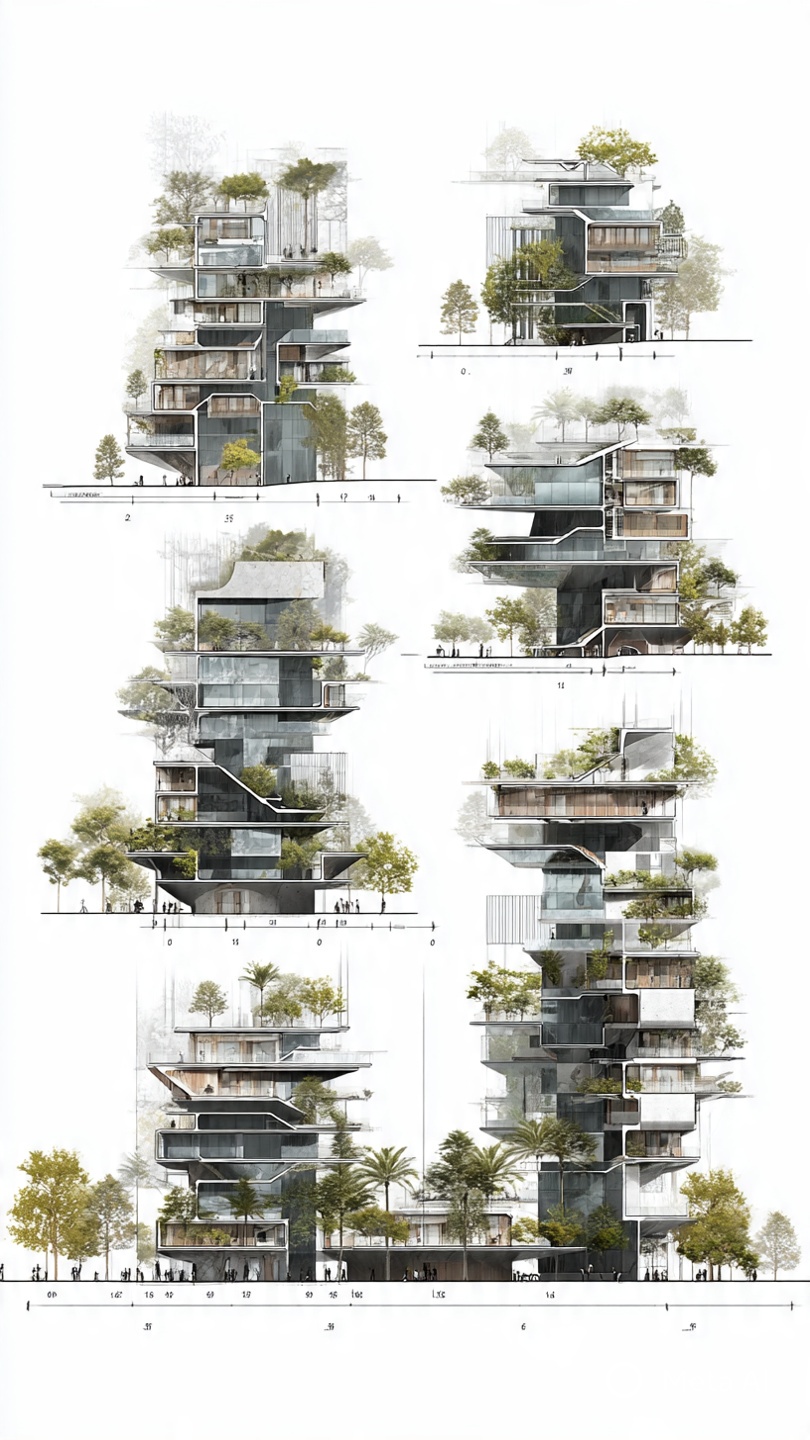
Housing Model — Hudson Hotel, 357 West 57th Street, Manhattan
The housing model for the former Hudson Hotel reimagines the site as a hybrid residential and civic ecosystem, transforming a single-use hospitality building into a mixed-tenure, mixed-use housing framework that responds to Midtown West’s affordability pressures, transient populations, and service-worker displacement.
Housing types are deliberately distributed to balance deep affordability, housing stability, and programmatic flexibility. The model integrates a layered mix of supportive housing, deeply affordable units, workforce and middle-income housing, and limited transitional or short-term units—reflecting the building’s history of temporary occupancy while redirecting it toward long-term social value. No single tenure dominates; instead, housing types are interwoven vertically and programmatically to avoid stratification and to promote shared access to light, views, and common amenities.
Hybridization occurs both within the building and across time. Former hotel room typologies are selectively aggregated to support a range of unit sizes and household structures, including single adults, small families, and non-traditional or intergenerational living arrangements. Shared kitchens, communal floors, and collective support spaces supplement private units, allowing density without isolation. Transitional housing components are designed to convert over time into permanent affordable units, embedding adaptability into the housing system.
The residential mix is supported by integrated social infrastructure—health, counseling, job training, cultural programming, and community-serving ground-floor uses—positioning housing as part of a broader care and support network rather than a stand-alone real estate product. Public-facing programs reconnect the building to the street and surrounding neighborhood, countering the inward-facing logic of the former hotel.
Overall, the Hudson housing model uses distribution and hybrid mix as tools of equity, leveraging an existing building and a prime Manhattan location to create long-term, non-speculative housing capacity. The project reframes adaptive reuse as a mechanism for redistributing access to central-city resources, while testing how hybrid housing systems can absorb instability, support diverse residents, and evolve over time without displacement.
Here are notable NYC examples of hybrid housing models — projects that mix housing types, tenures, and/or uses in ways that go beyond standard mono-typology developments (mix of affordable/supportive/creative/useful urban models). These can inform hybrid mix thinking for your Hudson Hotel or related work:
90 Sands — Supportive + Affordable Housing (DUMBO, Brooklyn)
Model: Former hotel converted into a mixed housing building with supportive housing for people exiting homelessness alongside affordable units for low- to moderate-income households. It also includes community and service spaces integrated into the project. Breaking Ground has pioneered this hotel-to-housing conversion model in NYC.
Why relevant: Mixed resident profiles (supportive + affordable), co-located services, reused building typology — not segregated by floor or facade but integrated across the building program.
Bridge Rockaway — Affordable + Industrial + Community Space (Brownsville, Brooklyn)
Model: First NYC project combining light industrial workspace on the ground floor with affordable and supportive housing above, plus community amenities and landscaped outdoor space.
Why relevant: Demonstrates hybrid uses beyond just housing — living and working spaces co-located, blurring the boundary between residential and economic life in a single development.
Carmel Place (Micro-Units + Mixed Income, Manhattan)
Model: Micro-apartments with a mix of market units, affordable units, and supportive units for veterans/low-income residents within one building. It uses modular construction and a pilot zoning framework to push typological innovation.
Why relevant: Though smaller in scale, its mixed income/tenure within a compact footprint shows another way to blend different household needs and demographic profiles in one building.
Hunter’s Point South (Long Island City, Queens)
Model: A large mixed-use neighborhood redevelopment with thousands of units, where a significant portion is mandated to be affordable and integrated with parks, public infrastructure, and commercial space.
Why relevant: While not a single building, its deliberate integration of multiple income levels, public space, and services illustrates how mix and hybrid distribution function at scale.
Mixed-Use + Affordable + Cultural/Institutional (Emerging Projects)
There are several mid-city developments planned or approved that explicitly combine affordable homes with community facilities, rec centers, or institutional uses(e.g., Hudson Mosaic with affordable units + recreation center).
Why relevant: These reinforce the idea of housing embedded in a broader socio-urban ecosystem, not isolated as purely residential.
Mixed-Use/Commercial + Housing Models (60 Water Street, etc.)
Projects like 60 Water Street in DUMBO, while conventional, have mixed components — affordable homes within larger mixed-use developments that include retail, schools, and parking (with inclusionary housing set-asides).
Why relevant: They show policy-driven hybrid distribution — commercial, public, and varied affordability bands integrated under conventional market structures.
Key Takeaways for Hybrid Mix Frameworks
From these examples, you can draw several patterns relevant to your housing model:
Integrated Supportive + Affordable Units
Projects like 90 Sands blend supportive services + housing for vulnerable populations with broader affordable housing, not isolating one group on separate floors.
Cross-Sector Uses
Bridge Rockaway’s mix of residential with industrial/workspace shows creative ways to tie housing to economic opportunity within one project.
Typological Diversity Within One Development
Carmel Place demonstrates unit size/tenure diversity (micro-units, supportive units, market units) in one compact building.
Mix at Neighborhood Scale
Larger developments (Hunter’s Point South, Midtown rezoning plans with affordable housing inclusion) show how mixed housing ecosystems can scale across urban blocks and districts.
de.Sign Studio | New York

Leave a Reply