
A Critique of the Vision Plan
Abstract
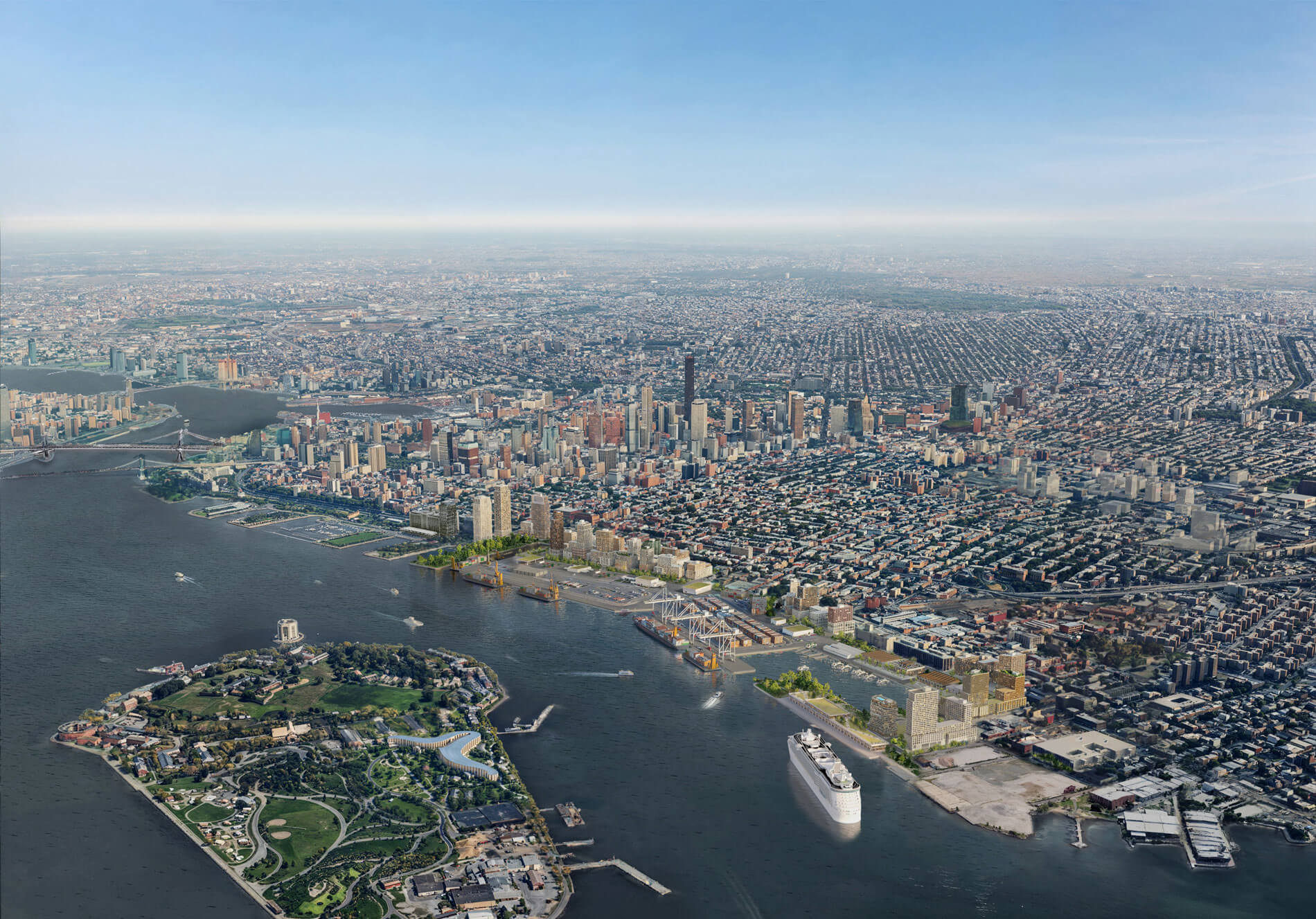
The recently approved Brooklyn Marine Terminal (BMT) Vision Plan represents one of New York City’s most ambitious waterfront redevelopment initiatives of the early twenty-first century. The plan integrates maritime modernization, mixed-income housing, public open space, and climate resilience strategies within a 122-acre site at the confluence of Red Hook and the Columbia Waterfront District. While the project has been lauded for its holistic aspirations — particularly the creation of an all-electric port and thousands of affordable housing units — it also reveals unresolved tensions around infrastructure, displacement, and the industrial-residential interface. This critique situates the BMT Vision Plan within broader discourses of post-industrial waterfront redevelopment, urban resilience, and equitable growth, highlighting both its promise and its risks.
Introduction
Urban waterfronts have long been contested terrains, emblematic of shifting economies and ideologies of urban form. From Baltimore’s Inner Harbor to Hamburg’s HafenCity, the late twentieth and early twenty-first centuries have seen a proliferation of projects that attempt to reconcile industrial heritage with residential, commercial, and leisure demands (Marshall, 2001; Hein, 2019). New York City’s Brooklyn Marine Terminal Vision Plan (2025) situates itself within this lineage, proposing an unprecedented mixture of maritime infrastructure, housing, and green space.
This critique interrogates the Vision Plan as an architectural and urban design proposition, examining its capacity to deliver on stated goals of resilience, affordability, and industrial modernization. It argues that while the plan demonstrates progressive ambitions, unresolved issues around mobility, socio-spatial justice, and long-term governance threaten to undermine its transformative potential.
Programmatic Strengths
Integration of Uses
A key strength lies in the plan’s integration of programmatic functions across a substantial waterfront site. By pairing a 60-acre electrified port with approximately 6,000 housing units (of which 2,400 are designated as permanently affordable) and 28 acres of public open space, the project embodies what Banham (1971) termed “the ecology of the built environment” — a multi-scalar assemblage that resists single-use zoning. The mix holds potential to animate the waterfront as a genuine urban neighborhood rather than an isolated logistics enclave.
Resilience and Sustainability
The emphasis on decarbonization — through an all-electric port and strategies to reduce truck traffic — aligns with contemporary debates on sustainable urban logistics (Hesse & Rodrigue, 2004). Likewise, proposed flood protections and resilient infrastructure respond to the vulnerabilities exposed by Hurricane Sandy (2012). In this sense, the BMT plan resonates with Pelling’s (2011) framework of “resilience as transformation,” positioning infrastructure not merely as protective barrier but as catalyst for new forms of urban life.
Public Benefit and Economic Promise
Projected job creation (37,000 construction jobs and 2,000 permanent positions) and investments in local amenities such as parks and schools suggest attention to distributive equity. This contrasts with earlier waterfront projects in New York, such as Battery Park City, which have been criticized for privileging elite consumption (Zipp, 2010).
Critical Weaknesses
Mobility and Infrastructure Deficits
The most pressing critique concerns the lack of robust transportation planning. Despite references to shuttle services, bus restorations, and greenway improvements, the plan does not resolve how thousands of new residents and port workers will access the site within an already constrained street network. The tension between freight circulation and residential mobility recalls Meyer’s (1999) warning that “urban ports must negotiate the frictions of incompatible temporalities” — the 24-hour rhythms of logistics versus the diurnal rhythms of domestic life. Without binding transit commitments, the risk is infrastructural paralysis.
Risks of Displacement and Gentrification
Although 2,400 affordable units are commendable, the majority of the proposed housing will be market-rate. This raises concerns of socio-spatial displacement, particularly in adjacent Red Hook, a neighborhood historically characterized by working-class and public housing communities. The Vision Plan thus illustrates Smith’s (1996) concept of the “revanchist city,” wherein redevelopment cloaked in public benefit catalyzes real estate valorization and resident displacement.
Industrial–Residential Interface
The plan attempts to co-locate an active maritime port with large-scale residential development. While mixed-use has become an urbanist mantra, industrial–residential adjacency often produces frictions of noise, emissions, and heavy vehicular traffic (Ferm & Jones, 2016). The absence of clearly articulated transition zones, buffers, or design guidelines risks creating an environment of mutual disruption rather than synergy.
Governance and Implementation
Finally, the plan’s reliance on a General Project Plan mechanism to override zoning, coupled with long phasing horizons extending into the late 2030s, raises questions of accountability. As Flyvbjerg (2014) notes, megaprojects are particularly susceptible to cost overruns, schedule slippage, and optimism bias. Without strong governance structures and community oversight, the BMT project risks becoming another case of “planning fallacy” in urban infrastructure.
Discussion: Theoretical Implications
The BMT Vision Plan exemplifies the contradictions of contemporary urban design in post-industrial cities. On one hand, it aspires to embody resilience, sustainability, and equity. On the other, it replays unresolved tensions — between housing demand and industrial retention, between short-term political urgency and long-term infrastructural feasibility, between promises of affordability and the realities of gentrification.
From a design perspective, the project challenges architects and urbanists to think beyond spatial form toward systemic integration: how to design for coexistence of incompatible uses, how to operationalize resilience at multiple scales, and how to inscribe equity into the very DNA of masterplans. The BMT plan’s partial answers to these questions invite continued critique and refinement.
Conclusion
The Brooklyn Marine Terminal Vision Plan offers a compelling vision of a multifunctional, resilient, and ostensibly inclusive waterfront. Yet as with many ambitious urban megaprojects, its transformative promise depends less on renderings and proclamations than on the mundane yet crucial details of transit investment, affordability enforcement, environmental remediation, and governance transparency.
For scholars and practitioners of architecture and urban design, the BMT Vision Plan thus stands as both opportunity and caution: a laboratory for rethinking the twenty-first century port city, but also a reminder of the enduring risks of infrastructural optimism and social displacement.
References
- Banham, R. (1971). Los Angeles: The Architecture of Four Ecologies. Harper & Row.
- Ferm, J., & Jones, E. (2016). Mixed-use “policy” in practice? Some evidence from London. Town Planning Review, 87(2), 165–185.
- Flyvbjerg, B. (2014). What you should know about megaprojects and why: An overview. Project Management Journal, 45(2), 6–19.
- Hein, C. (2019). Port Cities: Dynamic Landscapes and Global Networks. Routledge.
- Hesse, M., & Rodrigue, J.-P. (2004). The transport geography of logistics and freight distribution. Journal of Transport Geography, 12(3), 171–184.
- Marshall, R. (Ed.). (2001). Waterfronts in Post-Industrial Cities. Spon Press.
- Meyer, H. (1999). City and Port: Urban Planning as a Cultural Venture in London, Barcelona, New York, and Rotterdam. International Books.
- Pelling, M. (2011). Adaptation to Climate Change: From Resilience to Transformation. Routledge.
- Smith, N. (1996). The New Urban Frontier: Gentrification and the Revanchist City. Routledge.
- Zipp, S. (2010). Manhattan Projects: The Rise and Fall of Urban Renewal in Cold War New York. Oxford University Press.

Leave a Reply