
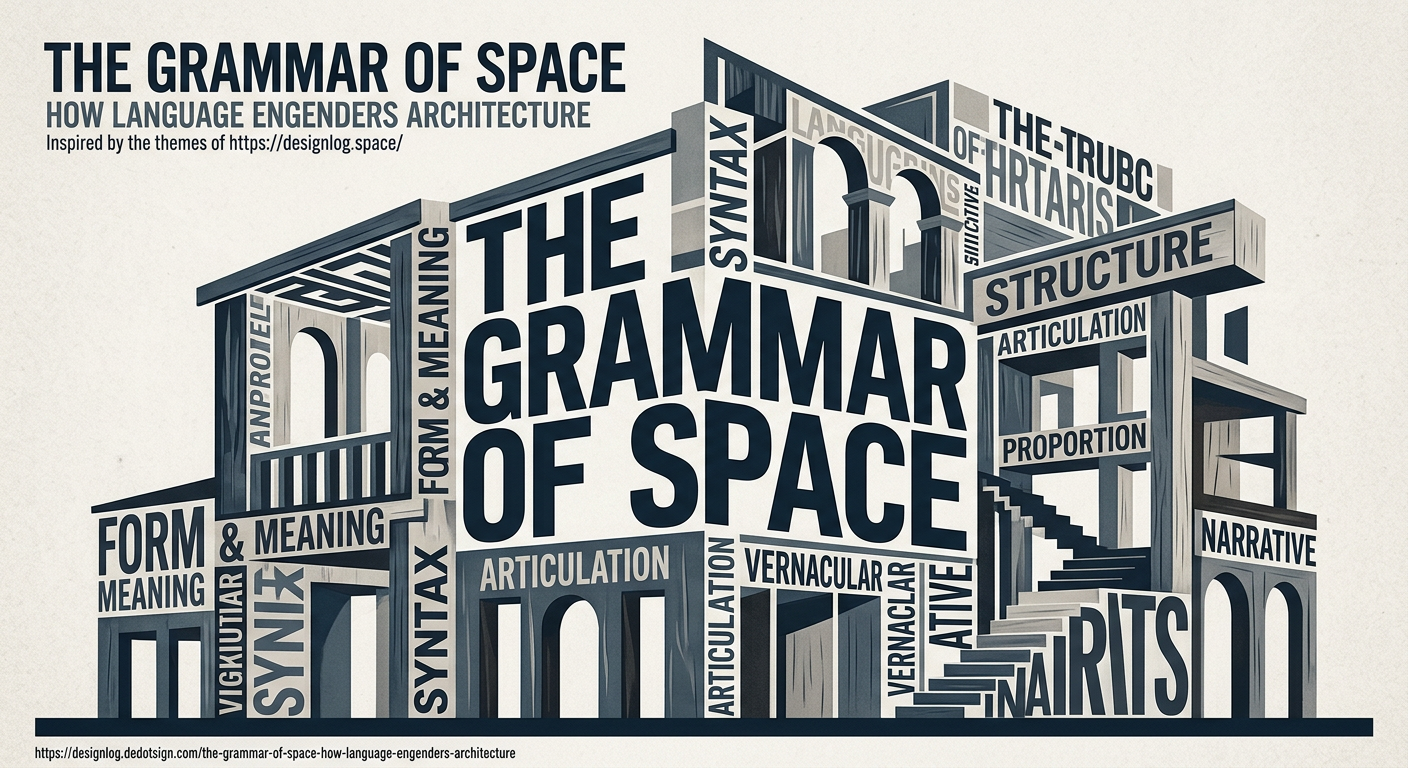
The Grammar of Space: How Language Engenders Architecture
Architecture is often described as a language: buildings “speak,” façades “signify,” and cities become texts to be read. Yet the more provocative proposition is the inverse—that language itself can engender architecture. If architecture is not merely an object of representation but a material organization of relations, then linguistic structures offer more than metaphors for understanding space: they provide models through which space may be conceived, ordered, and produced.
Every language establishes distinctions. It separates subject from object, foreground from background, presence from absence; it orders events through tense, relations through syntax, and experience through categories of naming. Architecture similarly constructs a world by deciding what is continuous or discontinuous, inside or outside, public or private, central or peripheral. The architectural plan can therefore be understood as a kind of spatial syntax: rooms operate as units, thresholds as punctuation, corridors as connective devices, and courtyards as voids whose absence is nevertheless structurally active. To design is, in this sense, to establish rules for how elements may encounter one another.
This analogy becomes especially productive when one moves beyond the simplistic claim that “architecture is a language.” Linguistic systems do not merely contain vocabularies; they possess grammars capable of generating indefinitely many utterances from finite rules. Architecture, likewise, can be conceived as generative. A limited repertoire of elements—wall, column, opening, stair, roof, enclosure—can produce radically different spatial worlds depending upon the rules governing their combination. What matters, then, is not the isolated architectural element but the relations that make an element meaningful.
The history of architecture repeatedly demonstrates such linguistic tendencies. Classical orders established something resembling a grammatical system in which columns, entablatures, proportions, and ornament could be combined according to conventions. Modernism subsequently attempted to construct another syntax, one that privileged structural clarity, abstraction, repetition, and functional organization. Postmodern architecture deliberately reopened the question of architectural vocabulary, treating historical forms as signs capable of quotation, irony, and recombination. In each case, architecture was not simply describing a cultural language; it was participating in the construction of one.
The comparison can be extended to multilingualism. A city is rarely governed by a single spatial grammar. Its architecture records successive linguistic, political, religious, and economic regimes: indigenous spatial practices encounter colonial geometries; vernacular construction confronts imported standards; informal settlements develop alongside bureaucratic planning. The resulting city resembles a polyglot text, not because its buildings literally translate words into forms, but because multiple systems of ordering coexist, overlap, contradict, and transform one another.
This perspective also complicates the familiar distinction between form and meaning. A doorway is not meaningful solely because it symbolizes passage; it organizes passage. A boundary does not merely signify separation; it produces differentiated territories. A street does not simply represent public life; it makes particular forms of encounter possible. Architecture therefore possesses something analogous to linguistic performativité: it does not only communicate meanings but helps bring social relations into existence.
The deepest implication is that architecture may be understood less as a finished “sentence” than as an open grammar. Its significance lies partly in what it permits others to say, do, inhabit, and imagine. Buildings endure beyond the intentions of their authors; inhabitants reinterpret them, appropriate them, and sometimes resist the spatial rules embedded within them. Like language, architecture is consequently both inherited and inventive—constrained by conventions yet capable of generating unforeseen forms.
To speak of languages engendering architecture, then, is not to claim that buildings can be reduced to linguistic structures. It is to recognize a shared epistemological condition: both language and architecture make worlds by organizing difference into relations. Language gives thought a syntax; architecture gives human coexistence a spatial syntax. Between the two lies not a simple analogy, but a generative reciprocity: we inhabit structures that shape what can be said, while the worlds we articulate continually reshape the structures in which we live.


Leave a Reply