
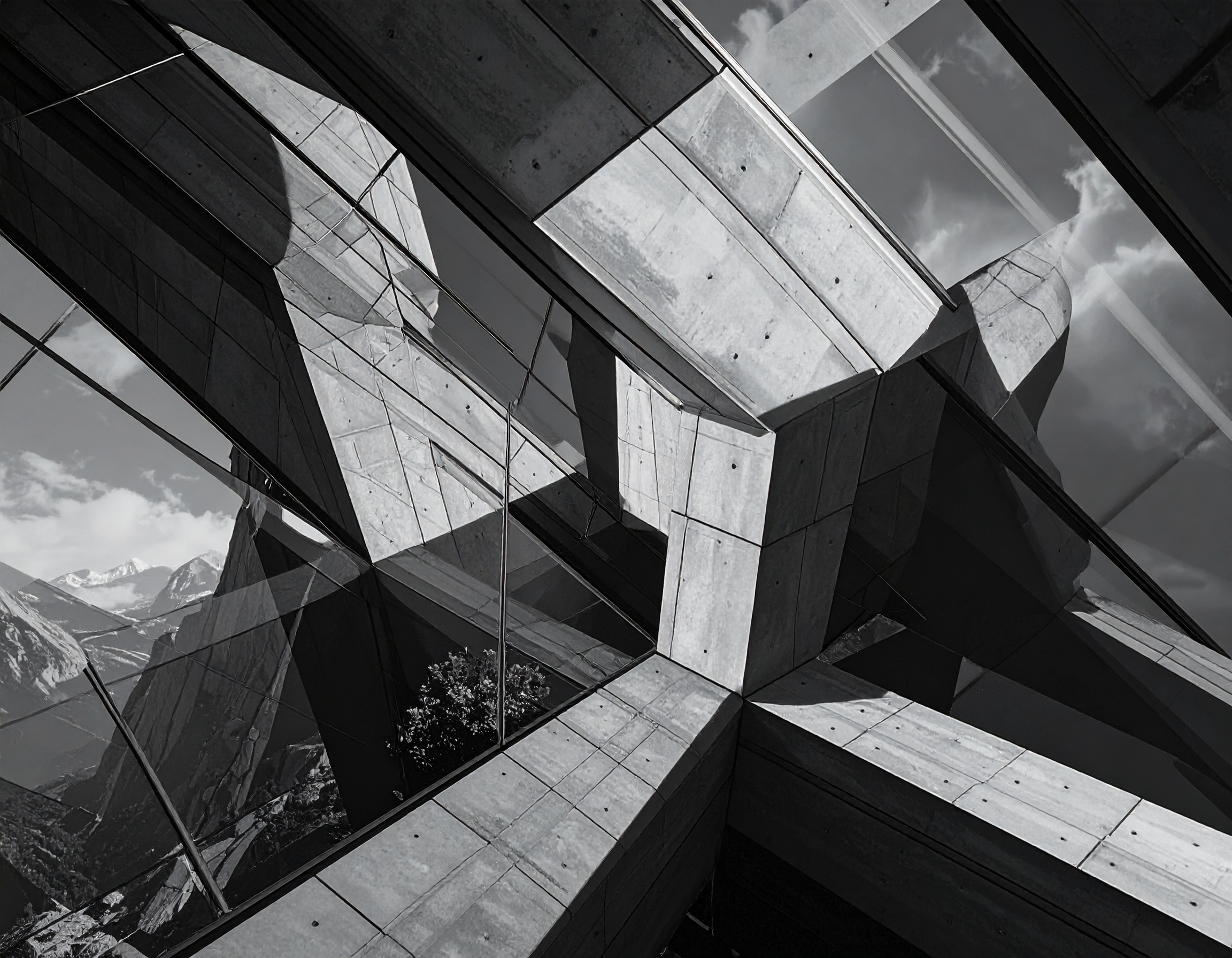
The Architecture of What Remains
An unbuilt project does not die.
It withdraws.
It leaves the world of matter and returns to the quieter territory from which architecture first came—the territory of thought, where a wall is not yet a wall but the possibility of separation; where a window is not yet an opening but the possibility of seeing; where a room is not yet inhabited but already contains the shape of an absence.
Perhaps this is what an architect truly builds first: not buildings, but conditions for existence.
The drawing is only the first evidence.
Before concrete, there is intention. Before intention, there is doubt. Before doubt, there is the blankness from which the project slowly begins to speak.
I begin with a line.
It is almost nothing.
A graphite mark on paper. A gesture without weight. It does not know yet that it will become a wall, a threshold, a boundary between one kind of silence and another. I draw another line, and suddenly there is a distance between them. That distance becomes inhabitable. A room appears—not because I have drawn a room, but because I have drawn the possibility of someone being there.
This is the strange beginning of architecture.
It begins with absence.
We spend our professional lives making things visible, yet the first act of designing is always an act of seeing what is not there.
The site is empty, but I do not experience it as empty.
There are traces everywhere.
The direction of light in the morning. The heat stored in a wall. The movement of people across an invisible desire line. The sound of traffic dissolving into distance. The memory of something that stood there before. The possibility of something that might stand there after I am gone.
A site is never simply land.
It is time made horizontal.
And when I place a building upon it, I am not placing an object into emptiness. I am entering a conversation that began long before I arrived.
Perhaps architecture is listening before it is making.
I draw because I am trying to listen more precisely.
A plan begins to emerge.
Rooms gather around a void. Circulation becomes a kind of sentence. A staircase folds upward through space, carrying the body from one condition of light into another. A courtyard becomes a pause. A wall becomes an edge, but also an invitation to cross it.
Slowly, the project begins to acquire an interior life.
It develops preferences.
It wants the morning sun.
It refuses a certain view.
It opens itself toward one direction and closes itself toward another.
It begins to behave less like an object and more like a living proposition.
And then I begin to inhabit it.
Not physically, of course.
I inhabit it through imagination.
I know where I would stand if I were waiting for someone. I know where rain would collect. I know which corner would become warm in winter. I know where a child might run, where an old person might pause, where two strangers might unknowingly occupy the same patch of light.
The building exists before the building exists.
This is perhaps the most intimate part of being an architect.
For a while, a building belongs only to you.
No one else has entered it.
No one else has seen its rooms.
No one else knows that behind a certain wall there is a small opening intended to frame the sky at four in the afternoon.
It is a private world.
And then you begin to show it to people.
The project leaves you.
It enters the room as drawings, models, diagrams, numbers, schedules. Suddenly the thing that lived inside your mind must learn to speak another language.
The language of cost.
The language of regulation.
The language of feasibility.
The language of ownership.
The language of time.
And architecture, which began as possibility, is gradually asked to become certainty.
How much?
How soon?
How many square metres?
How many floors?
How much can be removed?
How much can be saved?
What is necessary?
What can disappear?
There is something almost violent about these questions.
Not because they are unreasonable, but because architecture is born ambiguous and the world demands that it become precise.
A room can be measured.
A feeling cannot.
A courtyard has an area.
The memory it might create does not.
A window has a dimension.
The particular quality of light that might enter through it belongs to another order of knowledge.
Still, we measure.
We calculate.
We revise.
We defend.
We compromise.
And sometimes, after all of this, the project stops.
No ceremony announces its death.
There is no funeral for a building that never existed.
The client changes direction.
The land changes hands.
The budget becomes impossible.
The permissions do not arrive.
Another priority takes its place.
A decision is made in a room far away from the drawings, and somewhere, quietly, an architecture ceases to become.
The site remains.
The world continues.
And the architect closes the folder.
But something remains strangely unresolved.
Because how does one grieve something that never had a body?
An unbuilt project is not an empty thing.
It is an occupied absence.
It contains all the lives that might have happened there.
All the footsteps that never sounded.
All the conversations that never took place.
All the shadows that never moved across its walls.
All the mornings that never entered its windows.
It is difficult to say where such a building goes.
Perhaps it goes nowhere.
Perhaps it stays exactly where it was conceived.
Perhaps the unbuilt is not somewhere else, but another condition of existence.
There is the building that exists in the world.
And there is the building that exists in possibility.
The first occupies space.
The second occupies imagination.
The first can be demolished.
The second is much harder to destroy.
Years can pass.
Other buildings can be completed.
Other drawings can cover the walls of the studio.
Other projects can demand attention.
Yet sometimes an old plan returns.
A forgotten section.
A model with a layer of dust.
A drawing whose paper has begun to yellow at the edges.
And suddenly, I remember.
Not only the project, but the person I was when I drew it.
This is what makes an unbuilt project strange.
It becomes a record not of a building, but of a mind.
Every drawing contains a version of the person who made it.
The decisions I once thought were inevitable are now questions.
The walls I once believed necessary now seem arbitrary.
The openings I fought for now appear almost accidental.
Architecture reveals itself, years later, as a map of our uncertainties.
Perhaps this is why the unbuilt projects stay with us.
The built ones eventually become external.
They belong to the city.
They belong to their users.
They become photographed, occupied, altered, maintained, criticized, loved, neglected.
They develop a life independent of their author.
But the unbuilt remains inward.
It continues to belong to the imagination.
It does not weather.
It does not age.
Its concrete never cracks.
Its steel never rusts.
Its windows never collect dust.
No one paints over the colour I chose.
No one removes the door.
No inhabitant closes the courtyard with a fence.
The unbuilt remains forever suspended in that impossible moment before architecture becomes irreversible.
Perhaps that is its freedom.
Perhaps that is its sadness.
The built building must accept reality.
The unbuilt does not.
It can remain perfect, but only because it remains incomplete.
And there is a peculiar beauty in incompletion.
A finished building closes certain questions.
An unbuilt one keeps them open.
It asks:
What if?
What if the wall had moved?
What if the courtyard had remained open?
What if the building had turned slightly toward the west?
What if the budget had allowed one more room?
What if the project had survived?
What if it had not?
Architecture, in this sense, is not only the art of making spaces.
It is the art of negotiating with possibility.
Every project is an argument between what can be imagined and what can be made.
The architect stands somewhere between the two.
One foot in the world of necessity.
The other in the world of desire.
We are constantly translating between them.
And sometimes translation fails.
But failure, I have begun to think, is not always disappearance.
Sometimes an unbuilt project continues elsewhere.
A fragment migrates.
A proportion returns.
A detail survives.
A question becomes part of another project.
A particular way of bringing light into a room reappears years later in a different building, on a different site, for a different person.
The project was not built.
But something it taught me was.
This may be the quiet afterlife of architecture.
Not the preservation of form, but the continuation of thought.
A building can disappear and still alter the architect who designed it.
The unbuilt can become material.
Not material in the physical sense, but in the way memory is material.
In the way experience is material.
In the way an absence can begin to shape the things that come after it.
The building was never constructed.
Yet it constructed me.
I think of this often.
Because architecture is usually described as an act of making.
But perhaps it is equally an act of being made.
Every project changes the person who draws it.
Every site teaches the hand something.
Every failure leaves a geometry behind.
Every abandoned idea becomes part of the vocabulary of the next attempt.
We carry our unbuilt buildings with us.
Not visibly.
There are no photographs of them on the walls.
No plaques bear their names.
No city map records their addresses.
And yet they inhabit us.
Sometimes they appear in the way we place a window.
Sometimes in the hesitation before drawing a wall.
Sometimes in the instinct to leave something unfinished.
Perhaps the unbuilt project is therefore not an absence at all.
Perhaps it is an interior architecture.
A building that has turned inward.
A building without foundations, yet with depth.
A building without inhabitants, yet somehow inhabited.
A building that cannot be entered through a door, because the door is the mind that remembers it.
And maybe this is why I continue to draw.
Not because every drawing must become concrete.
Not because every line deserves to become a wall.
But because drawing is a way of keeping possibility alive.
To draw is to say:
This could exist.
This could become a room.
This could become a place for someone.
This could alter the way light touches the ground.
This could make a person pause.
This could make a city feel slightly different from what it was before.
And sometimes the world says no.
But the drawing has already said yes.
That yes does not disappear simply because the building does not.
It remains somewhere between paper and memory, between intention and matter, between what happened and what might have happened.
There are cities built of stone.
There are cities built of glass.
And there is another city, almost invisible, made of everything that was imagined but never constructed.
I think I have spent my life walking through that city.
I know its streets without having travelled them.
I know its rooms without having entered them.
I know the weight of its silence.
There are towers there that never reached the sky.
Houses that never held a family.
Libraries whose books were never opened.
Courtyards where no tree ever grew.
Bridges that cross no water except the distance between one thought and another.
It is a city without geography.
And yet it is real.
Perhaps architecture has always existed there first.
Before the stone.
Before the ground.
Before the building.
Before the world agrees that something should exist—
there is only the possibility of it.
And perhaps that is where the architect truly lives:
in the interval between imagining a place
and giving it permission to become real.
The unbuilt project remains in that interval.
Not finished.
Not failed.
Not gone.
Only waiting—
in the quiet architecture of what remains.

Leave a Reply