
“We do not dwell because we have built, but we build and have built because we dwell.”
— Martin Heidegger¹
At the root of Heidegger’s inquiry lies a rupture. His distinction between building and dwelling opens a chasm that continues to haunt architectural discourse: the ontological dissonance between shelter and home, between house and world. Yet in an era of mass displacement, real estate speculation, and climate migration, this rupture is no longer philosophical — it is lived. To dwell today is to be displaced. The house is no longer a center of gravity but a decentered node in a planetary matrix of precarity.
Heidegger’s notion of “being-at-home” was always more metaphysical than material, and herein lies both its strength and its blindness. For who, truly, was at home in the Black Forest? Not the marginalized, not the colonized, not the migrant. If Heidegger invoked the fourfold — earth, sky, mortals, and divinities — as a matrix of dwelling, it was a matrix guarded by cultural homogeneity. Today, that homogeneity has eroded. Dwelling cannot be understood without its shadow: the unhomely. As Homi Bhabha reminds us, the unhomely is not merely the opposite of home, but its haunting double — a space of cultural dislocation, temporal fragmentation, and existential ambiguity.² We carry our homes as wounds.
A House Without Doors: Dwelling Beyond Containment
Consider the refugee, the immigrant, the exile — bodies in search of spatial certainty, bearing homes not on their backs but in their memories. These are not merely displaced people; they are people who dwell in displacement. Their home is forever deferred. Mahmoud Darwish once wrote, “My homeland is not a suitcase, and I am no traveler.”³ Yet the suitcase has become the dominant architectural typology of our time — modular, portable, and perennially unpacked.
In this context, what becomes of the house? The architect’s house — whether a minimalist abstraction in Tokyo or a parametric flourish in Dubai — often seems alien to the rituals of dwelling. Architects design “houses,” but do they enable dwelling?
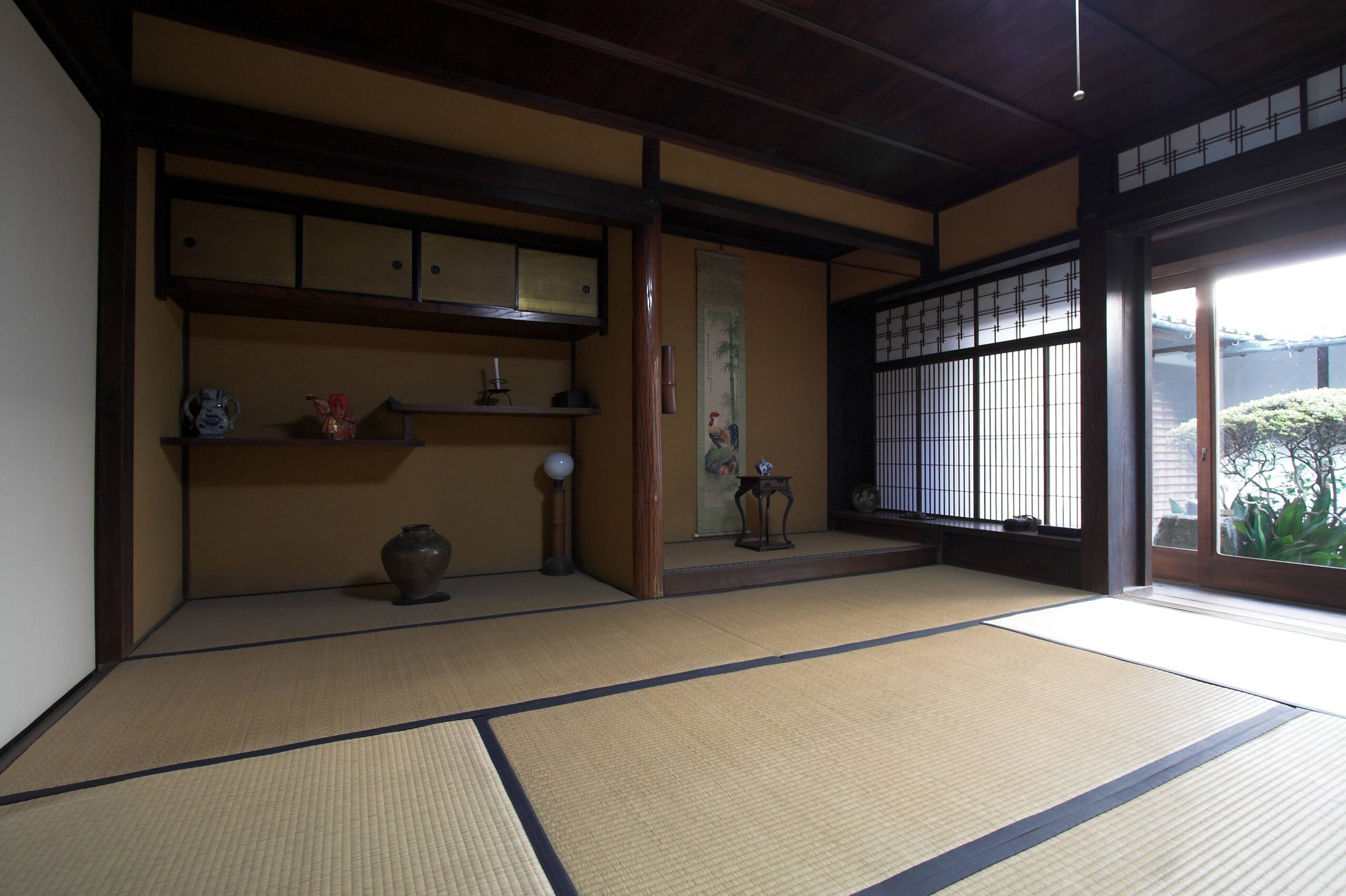
Jun’ichirō Tanizaki, in In Praise of Shadows, offered a gentle rebuke to modernist clarity. He wrote in defense of shadows, textures, and the subtleties of decay — elements erased by Western notions of progress.⁴ For Tanizaki, the Japanese home was not merely shelter, but a cosmological vessel, a space calibrated to impermanence. Today’s glass-and-steel homes, saturated with light and stripped of time, fail to make space for dusk — for transition, for ritual, for loss.
Dwelling as Becoming: The Yoga of Space
We might turn to Sri Aurobindo and Jiddu Krishnamurti — not architects, but radical spatial thinkers. For Aurobindo, the world is not a fixed container, but a field of evolving consciousness.⁵ Dwelling, then, is not located in architecture but in the soul’s unfolding. Similarly, Krishnamurti warned against the false security of homes. “You may have houses,” he wrote, “but are you ever at home?”⁶
Their philosophies suggest a different kind of spatial ethics — one not predicated on possession, permanence, or perimeter, but on presence. If the modern house is a container of property, theirs is a house of consciousness. Architecture becomes not form but practice. The house becomes a sadhana — a site of detachment and attention.
Home as Cultural Palimpsest
From a postcolonial lens, home is inseparable from violence. Colonization did not merely occupy land; it eradicated indigenous architectures of dwelling. In settler contexts like Australia, Canada, and the U.S., the act of building was a tool of erasure. To reimagine dwelling here is not about new materials — it’s about decolonizing the spatial imagination.
The Māori wharenui, the Indian haveli, the Swahili mji — these are not just buildings but cosmologies. They structure memory, identity, ritual, and relation.⁷ Yet global modernism, with its universalist claims, flattens these forms into decorative “vernaculars.” To resist this flattening, architects must go beyond form and engage with epistemic structures of dwelling.
The House as a Site of Struggle
The global housing crisis is not a crisis of design — it is a crisis of power. Architecture, increasingly co-opted by capital, builds for the investor, not the dweller. A house becomes “real estate,” not a home. In megacities from Manila to Lagos, São Paulo to London, people live within houses but outside of home.
Yet amidst this dislocation, there is spatial resistance. In the favela, the kampung, the basti — people build not just houses, but relations. In these self-built spaces, the act of building is the act of dwelling. Tim Ingold reminds us: home is not a product but a practice — a “wayfaring.”⁸
Architecture here is not a noun, but a verb.
Toward a Politics of Poetic Dwelling
What is needed is not more housing but a new ethics of home — a poetics of dwelling. This is not a nostalgic return to “authentic” forms, nor an abandonment of design. Rather, it is a call to architecture as attunement — to grief, memory, and transformation. We must design houses that hold not just light and air, but mourning, uncertainty, and hope.
In the end, the question is not What makes a house a home?
But rather: How can we dwell within the ruins of home’s promise?
This is not a rhetorical question. It is a design brief.
Bibliography
- Heidegger, Martin. Building Dwelling Thinking. In Poetry, Language, Thought, translated by Albert Hofstadter. New York: Harper & Row, 1971.
- Bhabha, Homi K. The Location of Culture. London: Routledge, 1994.
- Darwish, Mahmoud. Unfortunately, It Was Paradise: Selected Poems. Edited by Munir Akash and Carolyn Forché. Berkeley: University of California Press, 2003.
- Tanizaki, Jun’ichirō. In Praise of Shadows. Translated by Thomas J. Harper and Edward G. Seidensticker. New Haven: Leete’s Island Books, 1977.
- Aurobindo, Sri. The Life Divine. Pondicherry: Sri Aurobindo Ashram, 2001.
- Krishnamurti, Jiddu. Freedom from the Known. Edited by Mary Lutyens. San Francisco: HarperOne, 2005.
- Oliver, Paul. Dwellings: The Vernacular House Worldwide. London: Phaidon Press, 2003.
Ingold, Tim. “The Temporality of the Landscape.” World Archaeology 25, no. 2 (1993): 152–174

Leave a Reply