
Architectural history in India has long been shaped by a selective cartography—one that privileges monumental, imperial, and easily legible structures while marginalizing sites that resist dominant historical narratives. Beyond the canon of Mughal mausolea, Rajput forts, and colonial civic buildings exists a dense substratum of architectural production that remains physically present yet culturally obscured. These structures—stepwells embedded in suburban growth, palaces hybridized by transregional aesthetics, temples devoted to marginal cults, and abandoned capitals overtaken by landscape—constitute what may be described as un-erased architectures: sites that survive materially but have slipped from collective historical consciousness.
This essay examines a selection of such sites to argue that architectural invisibility in India is not the result of disappearance, but of historiographic neglect shaped by colonial epistemologies, nationalist simplification, and contemporary urban priorities. Together, these structures form an alternative spatial archive—an invisible geography that complicates linear narratives of Indian architectural development.
Palimpsests of Erasure: Colonial Substitution and Urban Memory
The Amir-ud-Daulah Library in Lucknow exemplifies architecture as palimpsest. Constructed during the colonial period atop the demolished pavilion Lanka, once associated with Nawab Wajid Ali Shah, the library embodies layered acts of substitution rather than outright destruction.¹ While the pavilion was erased physically, its spatial memory persists beneath the later structure. The building’s hybrid Indo-Islamic and colonial vocabulary reflects a broader pattern in which British urban interventions overwrote princely landscapes while selectively appropriating indigenous craftsmanship. The anonymity of the artisans who shaped this hybrid form further underscores how architectural labor, especially indigenous labor, is frequently excluded from historical record.
Such sites challenge the notion that colonial erasure was total. Instead, they reveal how power operates through architectural replacement—maintaining continuity of space while altering its symbolic ownership and meaning.
Subterranean Architectures and the Politics of Utility
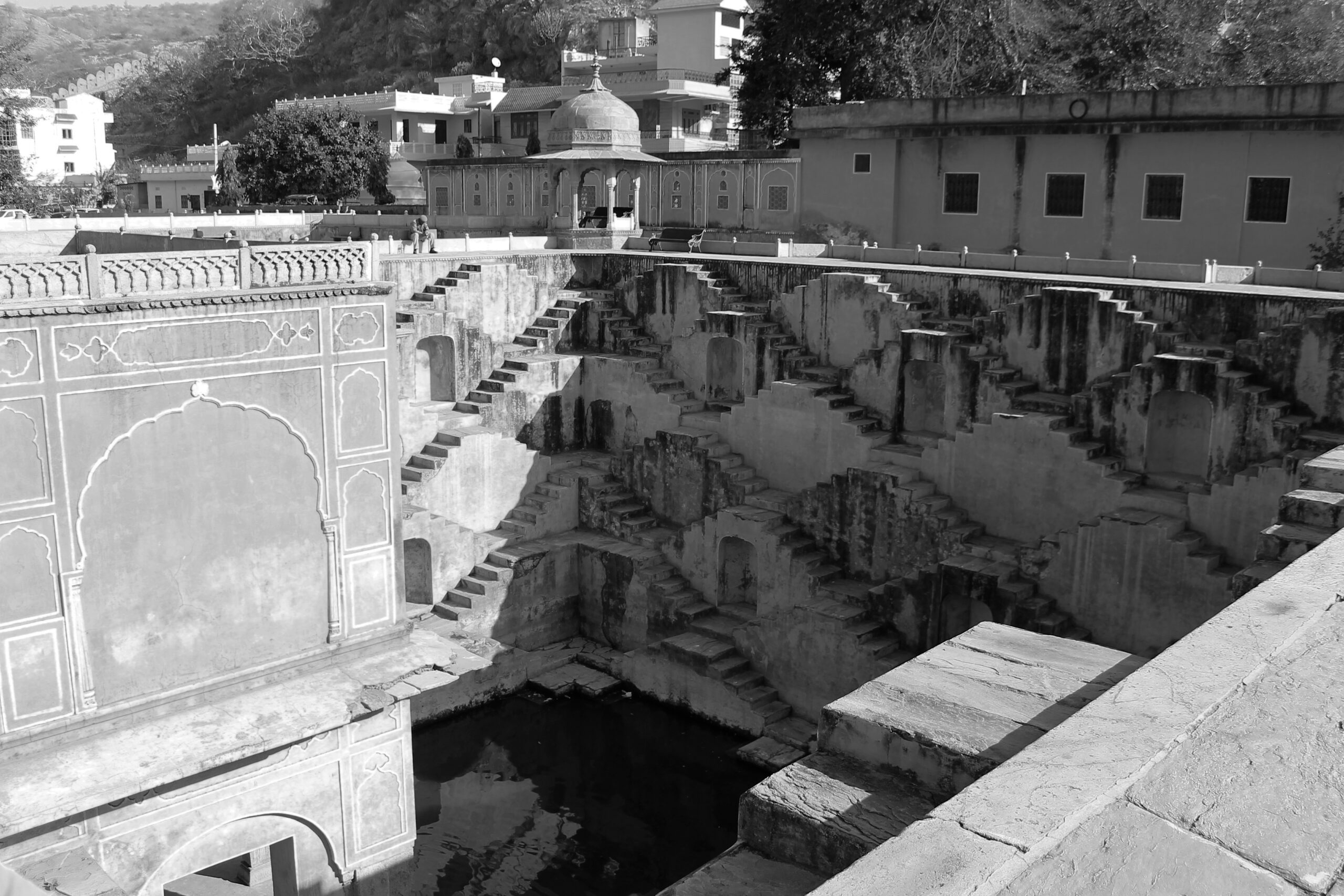
Stepwells represent one of the most sophisticated indigenous water-management systems in South Asia, yet they remain among the most neglected architectural forms in modern India. Dwarka Baoli in Delhi, dating to the Lodi period, survives today as a submerged artifact within an aggressively urbanized landscape.² Once a site of communal gathering and ritualized access to water, it has been rendered functionally obsolete by piped infrastructure and visually marginal by real estate development.
The neglect of stepwells such as Dwarka Baoli or Panna Meena Ka Kund reflects a modernist bias toward visible, vertical architecture and a corresponding devaluation of subterranean and vernacular systems.³ Their disappearance from public memory marks a broader disconnection from premodern ecological intelligence embedded in architectural form.
Circularity, Cult, and Non-Canonical Sacred Space
The Chausath Yogini Temple at Morena occupies a critical yet underexamined position in Indian architectural history. Its circular, open-air plan—housing sixty-four chambers dedicated to yogini deities—stands in contrast to the axial, hierarchical layouts of Brahmanical temple architecture.⁴ The temple’s form reflects esoteric tantric traditions and collective ritual practice rather than centralized worship.
Speculation regarding its influence on the circular plan of India’s Parliament building, whether direct or symbolic, is revealing. It suggests that indigenous spatial logics may inform modern civic architecture even as their origins remain unacknowledged.⁵ The temple’s marginalization thus reflects not architectural insignificance, but discomfort with its non-orthodox religious and gendered associations.
Hybridity and the Problem of Classification
Errum Manzil in Hyderabad and Dhanraj Mahal in Mumbai exemplify architectural hybridity that resists easy categorization. Errum Manzil’s Indo-European Baroque vocabulary—featuring classical columns, domes, and verandahs—reflects the cosmopolitan aspirations of the Deccan elite in the nineteenth century.⁶ Similarly, Dhanraj Mahal’s Art Deco idiom represents the convergence of princely patronage and global modernism in early twentieth-century Bombay.⁷
The relative invisibility of these structures within heritage discourse exposes a persistent bias toward stylistic purity. Hybrid architectures, particularly those that complicate binaries of “Indian” and “Western,” are often sidelined because they challenge nationalist frameworks that seek architectural authenticity in homogeneity rather than exchange.
Fusion as Method: Pattadakal and Early Medieval Pluralism
Pattadakal occupies a paradoxical position: internationally recognized yet conceptually underexplored. The deliberate co-presence of Nagara and Dravidian temple forms within a single complex represents not confusion, but architectural dialogue.⁸ In the early medieval Deccan, stylistic fusion functioned as a political and cultural strategy, materializing coexistence rather than dominance.
That this experiment remains peripheral in popular architectural narratives reveals a tendency to read Indian architecture through regional isolation rather than interaction. Pattadakal’s significance lies precisely in its refusal of stylistic boundaries.
Landscape, Ruins, and Abandoned Power
Sites such as Unakoti in Tripura and Rabdentse in Sikkim illustrate how architecture can dissolve back into landscape without vanishing entirely. Unakoti’s colossal rock-cut forms resist conventional definitions of building, existing between sculpture, terrain, and myth.⁹ Rabdentse, once a royal capital, now survives as fragmented ruins overtaken by vegetation.
These sites challenge preservation paradigms that prioritize intactness and monumentality. Their marginalization reflects a discomfort with ruins that emphasize impermanence and political discontinuity rather than dynastic success.
Neglect, Restoration, and the Threshold of Disappearance
The Bhand Devra Temple in Rajasthan—often termed “mini Khajuraho”—illustrates how proximity to canonical monuments can paradoxically hasten neglect. Despite its sculptural richness and Nagara form, the temple languished until recent restoration initiatives intervened.¹⁰ Its near-erasure underscores how heritage value is often comparative rather than intrinsic.
Conclusion: Toward an Ethics of Attention
These sites collectively reveal that architectural invisibility in India is not the result of loss, but of selective remembrance. They persist as material witnesses to alternative histories—of hybridity, ecological intelligence, marginal cults, and abandoned sovereignties. To map these un-erased architectures is to challenge the epistemological frameworks that govern heritage itself.
A scholarly engagement with such sites demands an ethics of attention rather than spectacle. It requires reading architecture not only as form, but as memory—layered, contested, and unevenly preserved. In doing so, we begin to redraw India’s architectural map not as a hierarchy of icons, but as a dense network of overlooked brilliance, still standing, still speaking, and still waiting to be heard.
Footnotes
- “Amir-ud-Daulah Library Built on Razed Pavilion Called Lanka,” Times of India, accessed January 2026.
- “Dwarka Baoli,” Wikipedia, accessed January 2026.
- “Hidden Historical Gems Near Jaipur for Architecture Lovers,” HerZindagi, accessed January 2026.
- “Chausath Yogini Temple,” Times of India, accessed January 2026.
- Ibid.
- “Errum Manzil,” Wikipedia, accessed January 2026.
- “Dhanraj Mahal,” Wikipedia, accessed January 2026.
- “Pattadakal,” Wikipedia, accessed January 2026.
- “8 Hidden Architectural Gems in India That History Nearly Lost,” The Better India, accessed January 2026.
- “ASI to Restore Rajasthan’s ‘Mini Khajuraho’ Bhand Devra Temple,” Times of India, accessed January 2026.

Leave a Reply