
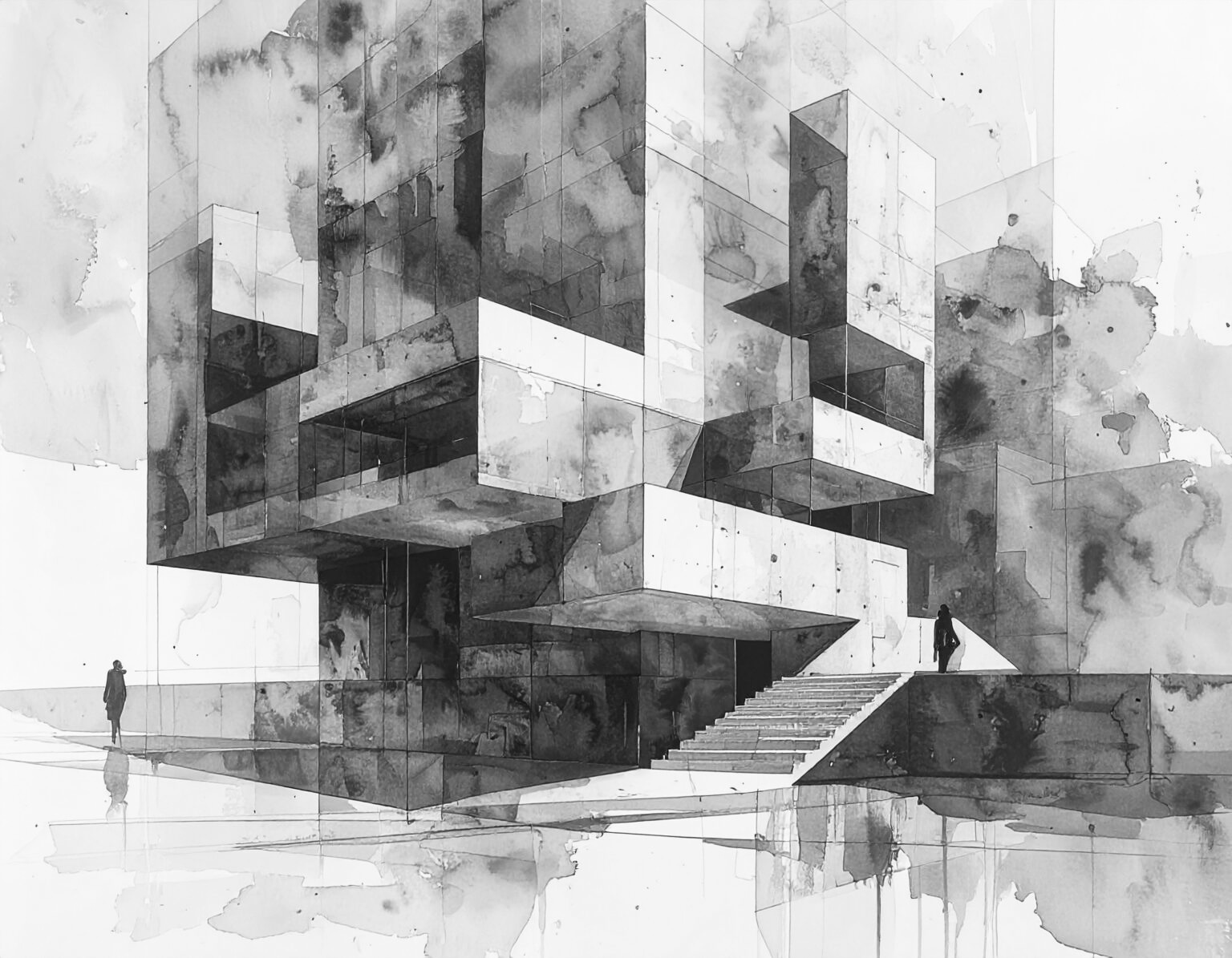
Jürgen Habermas is one of the most influential social and political philosophers of the twentieth century. Although his work primarily belongs to philosophy and sociology, particularly within Critical Theory, it has had a significant impact on architectural thinking. Habermas did not write extensively about architecture itself, yet his ideas about modernity, rationality, and the public sphere have shaped debates about architectural practice, urban design, and the social role of built environments.
A key concept in Habermas’s work is the Public Sphere—the arena in which citizens gather to discuss and debate matters of common concern. Architecture and urban spaces play a crucial role in enabling or restricting this sphere. Public buildings, plazas, libraries, and civic institutions can function as physical settings for democratic interaction. From this perspective, architecture is not merely aesthetic or technical; it becomes part of the infrastructure of democratic life. Habermas’s ideas encourage architects to consider how design can support open dialogue, accessibility, and civic engagement.
Habermas also defended the ongoing project of modernity, particularly in his famous essay related to the Venice Biennale 1980 debate about Postmodernism. During the late twentieth century, many architects rejected the rationalism of Modernism in favor of historical references, ornament, and irony. Habermas criticized this turn as “neo-conservative,” arguing that modernity’s emancipatory potential had not been exhausted. In architectural discourse, his critique suggested that abandoning modernist ideals risked retreating from the social ambitions that architecture once pursued—such as equality, rational planning, and universal accessibility.
However, Habermas’s approach to architecture has also faced criticism. One limitation is that his theory tends to privilege rational communication and consensus, while architectural experience often involves emotion, symbolism, and sensory perception. Critics influenced by thinkers such as Michel Foucault argue that space is not only a site for rational debate but also a mechanism of power and control. From this perspective, architecture cannot simply facilitate democratic discourse; it may also structure behavior, enforce surveillance, or reproduce social hierarchies.
Another critique concerns Habermas’s relatively abstract treatment of space. His theory of communicative action focuses on language and discourse rather than material environments. As a result, architects and urban theorists have had to interpret and adapt his ideas to spatial practice. Some scholars suggest that the complexity of cities—economic forces, cultural identities, and informal uses of space—cannot be fully explained through the framework of rational communication alone.
Despite these limitations, Habermas’s thought remains valuable for architectural theory. His insistence on the ethical and democratic dimensions of modernity encourages architects to see their work as part of a broader social project. Architecture, in this view, should not merely produce visually striking buildings but also contribute to inclusive public life and collective participation.
In conclusion, while Jürgen Habermas did not write a systematic theory of architecture, his ideas about modernity, democracy, and the Public Sphere provide a powerful framework for thinking about the social role of built space. A critical engagement with his work reveals both its strengths—its commitment to democratic ideals—and its limitations—its relative neglect of spatial and sensory dimensions. For architects and urban theorists, Habermas’s philosophy remains a productive starting point for reflecting on how architecture can shape public life in modern societies.

Leave a Reply