
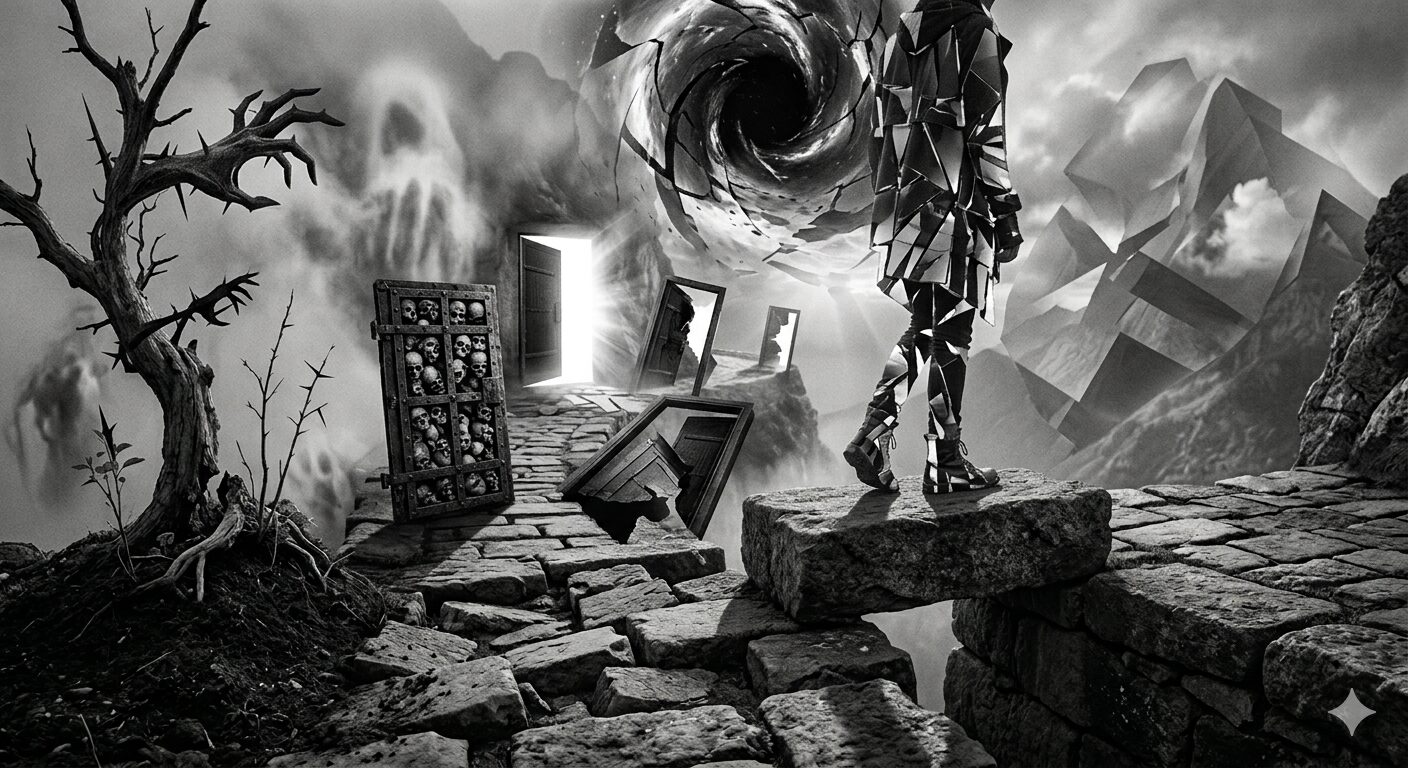
Notes from a Practice That Refuses to Resolve
I have begun to distrust success.
Not the kind measured in awards or publication—those have always felt peripheral—but the quieter, more insidious success of a building that performs exactly as expected. The plan is efficient. The circulation is clear. The details align. Nothing leaks, nothing confuses, nothing resists. It is, by all accounts, resolved.
And yet, I leave these buildings with nothing.
They do not stay with me. They do not trouble me. They do not ask anything I haven’t already agreed to give.
If architecture is meant to engage—to press against the body, to shape perception, to alter awareness—then what we call “failure” might be its most underused instrument. Not failure as incompetence, or neglect, or disregard for responsibility. That is not provocation; that is abdication. I mean something else: a deliberate incompleteness, a refusal to close the loop, a space that does not fully explain itself.
A productive failure.
I have felt it before, though I didn’t name it at the time. A building that almost works, but not quite. A path that leads, then hesitates. A room that seems too large for its purpose, or too small to be comfortable. A material that behaves unpredictably in light—absorbing in the morning, glaring by afternoon. At first, these moments register as flaws. But they linger. They demand a second reading.
Why does this feel off?
Why am I adjusting myself here?
In that adjustment, I become present.
Success, in contrast, often eliminates the need for presence. It anticipates me so thoroughly that I am never required to negotiate. Everything is where it should be. Every gesture is confirmed. The building and I agree too quickly.
Failure interrupts that agreement.
It introduces friction—not as obstruction, but as invitation. It asks for interpretation. It slows the body just enough for thought to catch up. It resists the smooth consumption of space.
I am beginning to think that architecture has leaned too heavily on resolution as its highest virtue. We are trained to solve, to clarify, to refine until nothing extraneous remains. The drawing becomes cleaner. The concept tighter. The building, inevitably, quieter.
But life is not resolved. It is contingent, contradictory, uneven. Why should the spaces that hold it pretend otherwise?
There is a kind of honesty in allowing a building to falter—strategically, precisely. A misalignment that reveals the joint rather than hiding it. A seam that refuses to disappear. A threshold that is neither fully inside nor outside. These are not oversights. They are decisions to let tension remain visible.
To refuse the lie of perfection.
Of course, there is risk here. Failure is difficult to calibrate. Too subtle, and it disappears into the background noise of use. Too overt, and it becomes affectation—a forced awkwardness that feels more like a performance than a provocation. The line between intentional failure and simple error is thin, and often only legible over time.
But perhaps that is the point.
A productive failure is not immediately legible. It unfolds. It requires repetition, return, memory. It asks the occupant to participate in making sense of it. In this way, failure extends the life of the building beyond first encounter. It cannot be consumed in a single pass.
I think of a stair that is slightly misproportioned—not enough to trip, but enough to disrupt rhythm. You ascend more carefully. You notice your footing. The body, briefly, is no longer automatic. Or a façade that weathers unevenly, exposing its orientation, its vulnerability to wind and rain. Over time, it becomes a record rather than an image.
These are small failures, but they accumulate into a different kind of experience—one that acknowledges time, use, and imperfection as active forces rather than problems to be solved.
In my own work, I see how often I have avoided this. I have corrected alignments that might have been left slightly off. I have simplified junctions that could have held complexity. I have chosen materials for their predictability rather than their capacity to surprise.
In doing so, I have removed the very conditions that might provoke engagement.
It is uncomfortable to admit this. We are taught, implicitly and explicitly, that failure is to be eliminated. That precision equals care. That clarity equals rigor. And these are not untrue. Buildings must stand. They must protect. They must function.
But beyond that baseline, there is room—perhaps a necessity—for something less certain.
Failure, in this sense, is not the opposite of function. It is the beginning of meaning.
It opens a gap between what is intended and what is experienced. And in that gap, interpretation begins. The occupant is no longer a passive recipient of space, but an active participant in its construction.
They notice. They question. They remember.
I do not mean to romanticize dysfunction. There are failures that harm, exclude, and degrade. Those must be named and corrected without hesitation. But there are others—quieter, more ambiguous—that offer something architecture too often withholds: the possibility of discovery.
A building that does not fully resolve leaves room for the occupant to complete it.
Or to resist it.
Or to misunderstand it entirely.
This lack of control is unsettling. It undermines the architect’s authority as the sole author of meaning. It accepts that the work will be interpreted, misread, even rejected. But it also grants the building a longer, more complex life—one not fixed at the moment of completion.
I am starting to think that the role of the architect is not to eliminate failure, but to edit it. To decide where it matters, where it can be allowed to persist, where it might even be amplified.
To design not just for use, but for reflection.
A resolved building is consumed quickly. It offers itself all at once.
A building that contains failure—carefully placed, deliberately unresolved—cannot be exhausted so easily. It resists closure. It asks to be revisited.
And in that revisiting, it continues to work.
Perhaps this is what I am after now.
Not perfection.
Not even coherence.
But a kind of productive unease—
a space that does not settle,
a form that does not finish its sentence.
Something that stays open.
Something that fails,
just enough
to matter.

Leave a Reply