
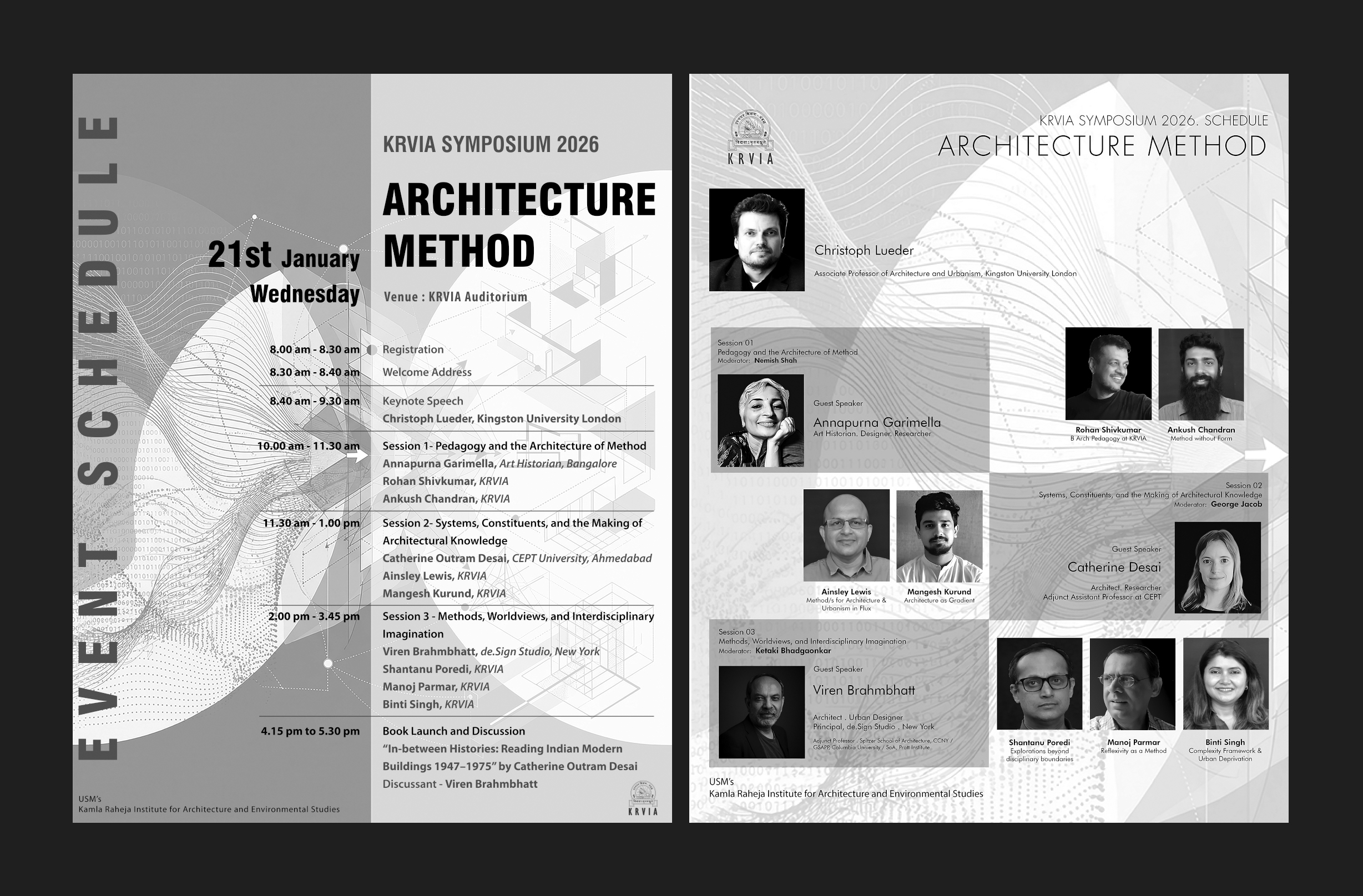
This symposium is positioned within pedagogy, and rightly so. But pedagogy does not exist apart from practice. The methods we teach become the defaults of professional action. What is rehearsed in the studio is what later shapes decisions, exclusions, and responsibilities in the world. To question architectural method pedagogically is already to intervene in practice.
Introduction: Method as a Way of Seeing
When we speak about method in architecture, we often imagine a sequence: analysis, concept, form, representation, construction. Method becomes procedural, almost administrative. But today I want to argue that method is something more foundational, and perhaps more unstable. Method is not only how architecture is made; it is how the world becomes legible to architecture in the first place.
Every method carries a worldview. It frames what counts as knowledge, what can be seen, what is ignored, and what is valued. In this sense, method is not neutral. It is a lens, a filter, and at times, a boundary.
Session 3 invites us to think across disciplines — dance, film, ecology, social sciences — not simply as sources of inspiration, but as alternative methods of world-making. My proposition today is that architecture does not merely borrow from other disciplines; it is constantly negotiating with competing epistemes. Architecture is shaped by these negotiations, and so is architectural education.
I want to ask three interrelated questions:
- What does it mean to understand architectural method as a worldview rather than a technique?
- How do interdisciplinary methods unsettle architectural assumptions about space, form, and representation?
- And finally, what might it mean to teach architecture not as mastery of method, but as the capacity to move betweenmethods?
Method Before Architecture
We often assume that architecture precedes method: that architecture exists as an object or discipline, and method is applied to it. But I would suggest the reverse. Method comes first. Before there is architecture, there is a way of seeing space, matter, time, and relation.
Consider this: a plan drawing already assumes a world that can be flattened, measured, abstracted, and controlled. A section assumes gravity as stable, ground as given, and bodies as secondary. These are not innocent assumptions; they are methodological commitments that shape architectural imagination.
If we look historically, architectural methods have always been tied to dominant worldviews:
- Renaissance perspective aligned architecture with humanism and optical mastery.
- Modernist functional diagrams aligned architecture with industrial rationality.
- Parametric workflows align architecture with computational logic and systems optimisation.
Each of these methods does not simply produce different buildings; they produce different worlds. They decide what matters.
So when we ask, “What is Architecture Method?”, we are really asking: What kind of world does architecture believe it is operating within?
Architecture as a System of Relations
The symposium’s reference to systems theory and fluid mechanics is particularly useful here. If architecture is understood not as a static object but as a dynamic system — of material, spatial, social, ecological, and technological relations — then method becomes the means by which these relationships are recognised and organised.
But systems thinking also exposes a problem: no system can perceive itself in totality. Every system has blind spots.
Architectural methods, especially when formalised within pedagogy, tend to stabilise certain relations while excluding others. For example:
- Structural logic often dominates over social use.
- Visual coherence often overrides temporal change.
- Representation often precedes occupation.
This is not because architects are careless, but because methods are selective by nature. They reduce complexity in order to act.
Interdisciplinary engagement becomes crucial not because it adds complexity, but because it reveals what architecture habitually leaves out.
Method as Process, Not Prescription
If method is a worldview, it is also a process — one that unfolds over time and changes in response to what it encounters. Architectural methods are rarely applied once and for all. They are adjusted, reinforced, abandoned, or contradicted as projects encounter material resistance, social feedback, political constraint, and ecological limits.
Seen this way, method is not a stable framework imposed on a problem, but a sequence of decisions made under conditions of partial knowledge. It operates through iteration, revision, and recalibration. Drawings are tested against use. Diagrams confront lived experience. Assumptions encounter friction.
This processual understanding of method aligns architecture with systems thinking, where feedback loops, delay, and non-linearity are central. Method becomes less about control and more about responsiveness. Its rigor lies not in consistency, but in its capacity to remain open to change.
Learning from Other Ways of Knowing
Let me turn now to a few disciplines mentioned in this session — not as metaphors, but as methodological provocations.
Dance: Space as Lived Time
Dance offers a method that understands space through the body and through time. Space is not a container; it is produced through movement, rhythm, balance, fatigue, and repetition.
From a dancer’s perspective:
- There is no neutral ground.
- There is no fixed centre.
- Space exists only through action.
If architectural method were informed by dance, we might prioritise sequences over forms, transitions over objects, and sensation over geometry. Importantly, dance resists permanence. It accepts disappearance as part of its method.
This challenges architecture’s obsession with stability and completion. What would it mean to teach architecture as something that is performed rather than merely constructed?
Film: Framing, Editing, and the Politics of View
Film introduces a method deeply concerned with framing, montage, and narrative. It acknowledges that what is shown is always partial and that meaning is constructed through juxtaposition.
Architectural representation often hides this fact. Plans and renderings present themselves as total views, as if the building were already known. Film, on the other hand, accepts that meaning unfolds over time and is shaped by movement, memory, and perspective.
A filmic method of architecture would ask:
- Who controls the frame?
- What is edited out?
- How does sequence shape interpretation?
In pedagogy, this could shift emphasis from final images to processes of selection and narration. Architecture becomes less about objects and more about how experiences are assembled.
Ecology: Architecture Without Autonomy
Ecology fundamentally disrupts the idea of architectural autonomy. It insists that no system operates in isolation and that every action has cascading effects.
Ecological methods privilege feedback, adaptation, and long-term consequences. They resist linear causality.
From this perspective, architectural method can no longer be extractive or purely problem-solving. It must be responsive, situated, and provisional.
This poses a challenge to architectural education, which often rewards clarity, authorship, and resolution. Ecological thinking suggests that good architecture may be unfinished, compromised, or even uncomfortable.
It asks us to consider ethics not as an add-on, but as embedded within method itself.
Social Sciences: Architecture as a Cultural Practice
Social sciences remind us that space is not neutral. It is produced through power, policy, economics, and social behaviour.
Methods from anthropology or sociology emphasise observation, participation, and reflexivity. They question the authority of the observer.
When architecture adopts these methods seriously — not superficially — it destabilises the idea of the architect as sole author. Knowledge becomes collective, situated, and contested.
This raises an uncomfortable but necessary pedagogical question: are we teaching students to design for others, or to design with them? And what methods make each possible?
Interdisciplinarity as Friction, Not Fusion
Interdisciplinary work is often celebrated as seamless integration. But I want to suggest that its real value lies in friction.
Different disciplines do not simply offer new tools; they challenge foundational assumptions. Their methods may be incompatible, resistant, or even contradictory.
This is productive.
Architecture should not aim to absorb other disciplines into itself, but to remain in dialogue with them — allowing its own methods to be unsettled.
In education, this means resisting the urge to translate everything back into architectural norms. Sometimes the most valuable outcome is not a building, but a question that cannot be resolved architecturally.
Method, Intuition, and Resistance
The symposium asks whether architecture can exist outside method — as intuition, accident, or resistance. I would argue that even these modes are not methodless. They simply operate with different logics.
Intuition is not the absence of method; it is method that has become embodied, tacit, and often unspoken. Accident reveals the limits of control. Resistance exposes the politics embedded in dominant methods.
In pedagogical terms, we should be careful not to romanticise intuition while dismissing method, or vice versa. The real task is to make methods visible, so they can be questioned.
Teaching architecture, then, is not about transferring methods as fixed recipes, but about cultivating methodological awareness:
- Why am I drawing this way?
- What does this diagram assume?
- Whose knowledge is being prioritised?
Architecture Method as Pedagogical Ethics
If method is worldview, then teaching method is an ethical act.
Every studio brief, representation requirement, or assessment criterion reinforces a particular way of seeing the world. Often, this happens unconsciously.
Session 3 invites us to ask: what if architectural education foregrounded method not as a tool to master, but as a position to interrogate?
This could mean:
- Encouraging students to work across incompatible methods.
- Valuing process over coherence.
- Allowing projects to remain unresolved.
- Teaching students to articulate not just what they designed, but how they came to see the problem.
Such an approach prepares architects not to apply fixed solutions, but to navigate complexity, uncertainty, and difference.
Conclusion: Architecture as Method-in-Question
I want to conclude by returning to the central provocation of this symposium.
Architecture Method is not something architecture possesses. It is something architecture continually negotiates. It evolves as worldviews shift, as technologies emerge, and as other disciplines challenge its assumptions.
In a time of ecological crisis, social transformation, and technological acceleration, the most urgent task for architecture may not be to refine its methods, but to remain open to their revision.
Interdisciplinary imagination does not offer architecture a new identity; it offers architecture a mirror. It shows us how partial our ways of seeing have been — and how much remains possible.
Perhaps the role of architecture today is not to define the world, but to learn how to see it differently, again and again.
Thank you.
Note: My presentation in Mumbai at KRVIA School of Architecture on Jan 21,2026: “Method in Architecture”: Method is the quiet discipline behind architectural clarity. It is not a style, but a way of thinking—how questions are framed, constraints are weighed, and decisions are tested. A strong method turns intuition into intention, allowing ideas to evolve through logic, context, and care. In architecture, method gives form to ethics, order to complexity, and resilience to design. It ensures that buildings are not just made, but understood—rooted in purpose, responsive to place, and capable of lasting beyond their moment.” / VB


Leave a Reply