
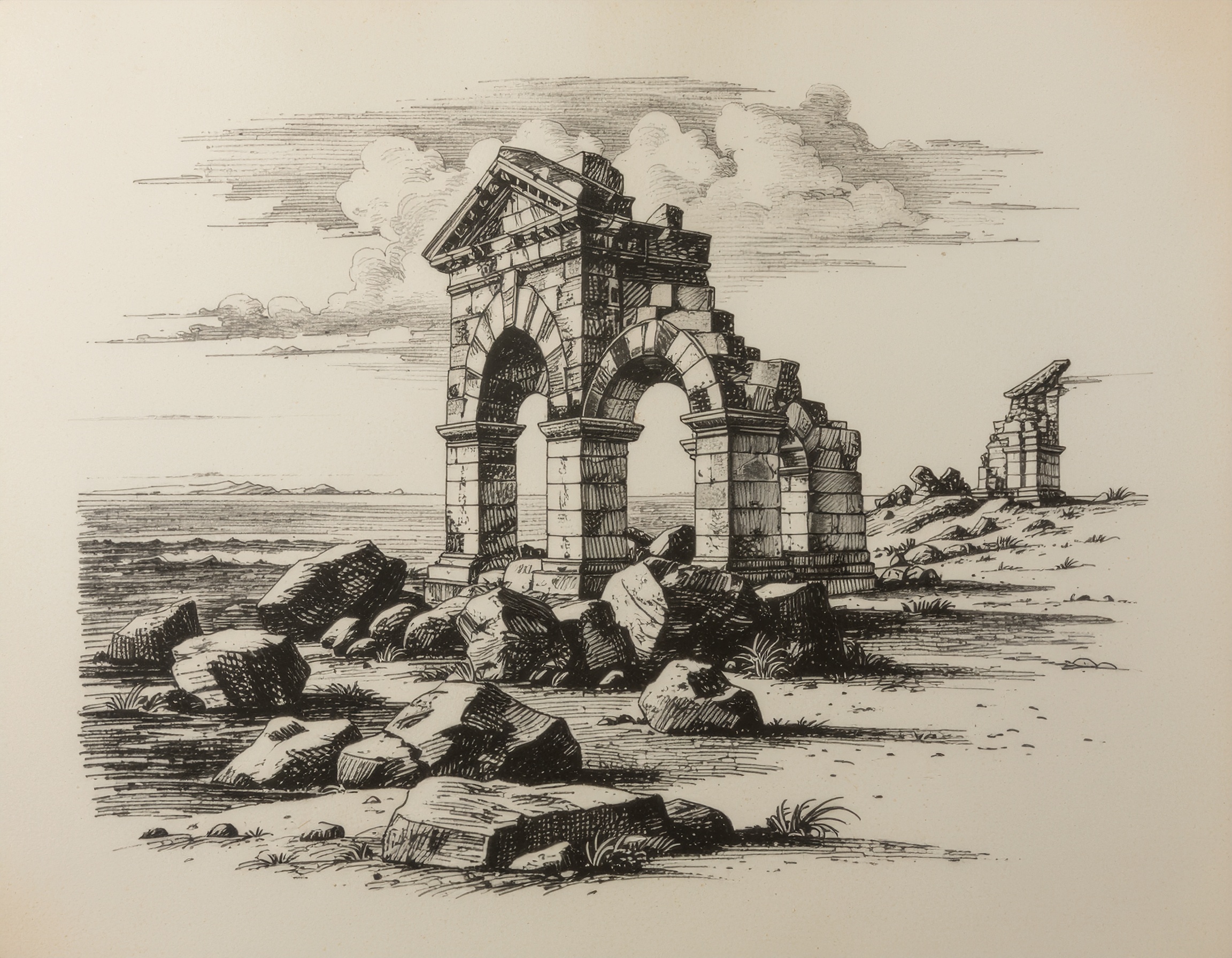
Ruins have long served as generative objects for intellectual reflection. As architectural remnants that mark temporal rupture, they exist in an ambiguous interval between persistence and disappearance. Their material incompleteness has historically encouraged meditations on theology, on the rise and fall of political orders, and on aesthetic theories of fragmentation, entropy, and the sublime. Yet contemporary scholarships increasingly recognize that ruins are not simply inert artifacts of historical decline. They are actively produced, interpreted, circulated, and instrumentalized through cultural, political, and spatial practices. Understanding ruins, therefore, requires attention not only to their materiality but also to the epistemologies and power structures that shape their representation. This essay proposes a critical theory of preservation that foregrounds these dynamics.
Historically, the European ruin-gazing traditions of the eighteenth and nineteenth centuries offer a telling case. Romantic artists and travelers interpreted the remains of antiquity or medieval monastic complexes as sublime markers of the limits of human ambition. Such writings cast ruins as universal emblems of time’s passage, abstracting them from the sociopolitical conditions that generated their decay. Recent work in postcolonial and heritage studies demonstrates, however, that these traditions were inseparable from colonial expansion and imperial collecting. Ruins across the Mediterranean and Middle East were mobilized as evidence of Europe’s self-appointed guardianship over “civilizational” history, while the people living among these sites were rendered invisible. The ruin’s aesthetic and theological significance, in other words, was constructed through the displacement of local narratives and the insertion of the material fragment into a Eurocentric temporal frame.
Contemporary scholarship on modern and industrial ruins extends and sharpens this critique. The abandoned factory, the derelict public housing block, or the bombed urban district embodies forms of structural violence tied to deindustrialization, racialized dispossession, and warfare. These environments challenge the contemplative detachment associated with earlier aesthetic traditions. Instead, they foreground the political economies that produce ruin conditions. Anthropologists and geographers have shown that such spaces index uneven development, environmental toxicity, and economic abandonment. From this perspective, ruins become evidence: they demand analytic attention to the state, to capital, and to the infrastructures whose failures render communities precarious. The act of looking at ruins thus becomes an ethical question—who benefits from the framing of decay as picturesque, and whose suffering is obscured by narratives of urban decline?
At the same time, ruins possess a speculative dimension that has become central to architectural theory. Their incomplete forms invite counter-narratives that challenge dominant historical trajectories. In critical urbanism, marginalized communities often repurpose ruined landscapes—vacant lots, abandoned buildings, contaminated sites—as spaces of survival, creativity, or political assembly. Futurist and decolonial design practices, including Afrofuturist and Indigenous futurist traditions, reconceptualize ruins not as endpoints of civilization but as points of departure for reconstructing alternative spatial futures. These speculative engagements invert the melancholic orientation of the Romantic ruin gaze: rather than looking backward with nostalgia, they mobilize ruins to envision emancipatory futures outside entrenched hierarchies of property, heritage, and state control.
These scholarly developments have significant implications for contemporary architectural practice. Decisions about preservation, transformation, or reclamation are embedded in broader debates about memory, identity, and collective responsibility. Preservation frameworks can stabilize cultural memory but may also freeze ruins within sanitized or state-authorized narratives that marginalize difficult or contested histories. Adaptive reuse and transformative design can reinvigorate structures but risk erasing the traces that render ruins historically legible. Reclamation—whether through ecological regeneration or community-led reoccupation—foregrounds questions of agency: who has the right to determine how a ruin’s meaning evolves, and how can designers support participatory forms of spatial stewardship?
Ultimately, treating ruins as research objects reveals them to be dynamic intersections of material decay, narrative production, and political struggle. They prompt scholars and architects alike to interrogate the mechanisms that shape public memory and to examine whose experiences are preserved, forgotten, or reimagined through built form. Engaging ruins critically thus entails acknowledging their entanglements with power while recognizing their potential as catalysts for spatial justice and future-oriented design. In this sense, ruins are not merely vestiges of the past but active participants in the ongoing negotiation of space, identity, and collective possibility.

Leave a Reply